
Короткий зміст
Ця стаття пояснює, як знаходити вільні ніші для бізнесу через пошук прогалин на ринку. Авторка розбирає 5 типів прогалин: у сервісі, у цілій ніші, в окремому товарі, в деталях товару та в комбінації рішень.
Головна ідея: вільна ніша — це не завжди новий ринок з нуля. Часто це незакритий запит, незручність покупця або сильна комбінація вже відомих рішень.
Для кого ця стаття
- Для підприємців, які шукають вільну нішу для запуску бізнесу.
- Для продавців на Etsy, Amazon, Shopify, які хочуть знайти нові товарні ідеї.
- Для виробників і креаторів, які хочуть зрозуміти, який продукт реально потрібен ринку.
- Для тих, хто хоче навчитися знаходити не “модні товари”, а ринкові прогалини з попитом.
Суть статті
- Прогалина на ринку — це попит, який ще не закритий існуючими товарами або сервісами.
- Є 5 основних типів прогалин: сервіс, ніша, окремий товар, деталь товару, комбінація.
- Найцінніші ідеї часто з’являються зі спостереження за незручностями людей, відгуками та повторюваними проблемами.
- Найкраще шукати нішу там, де ви добре знаєте цільову аудиторію.
- Ідеї потрібно перевіряти до масштабування: через відгуки, спільноти, питання до аудиторії та аналіз ринку.
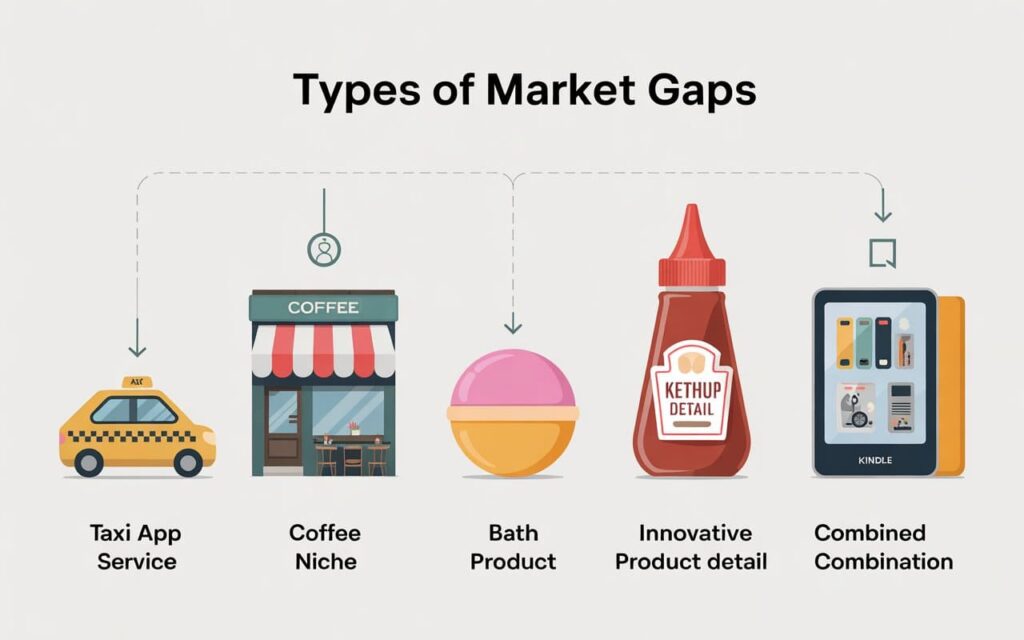
Таблиця: 5 типів прогалин на ринку
| Тип прогалини | Що це означає | Приклад |
|---|---|---|
| Прогалина в сервісі | На ринку немає зручного способу отримати послугу | Uber, Airbnb, модель хімчистки “як Uber” |
| Прогалина в цілій ніші | Є попит на окрему категорію, але вона ще не сформована як ринок | Starbucks, Spanx, Crocs, Blue Apron |
| Прогалина в окремому товарі | Усередині ринку бракує конкретного продукту | Lush Bath Bomb |
| Прогалина в деталях товару | Товар уже існує, але йому бракує важливої функції або покращення | Heinz upside-down bottle, Post-it, Nike Air |
| Прогалина в комбінації | Усі елементи окремо існують, але їх поєднання відсутнє | Kindle, Hydro Flask, Snuggie |
Examples of market gaps. Type 1: Service gaps

Uber
A person may not even realize that this gap exists because there is no product, no service. But as soon as it appears, they immediately understand: “Oh, how convenient this is now!” The most vivid example is Uber. They saw the opportunity. Instead of waiting a long time for a taxi and paying a very high price, they found a way to provide work to ordinary people who can just hop in, pick up passengers, and take them wherever needed. It was a remarkable gap, agree?
Airbnb and VRBO
Another good example is Airbnb. Previously, if a person went on vacation, they usually stayed in a hotel. But there was no single central place like VRBO or Airbnb now, where an ordinary person could rent out their apartment or house for a short period, and a place everyone would know about, where everyone could visit, and there would be many users — such a thing did not exist. They created this liquidity in the market and the ability to list their apartments or find interesting, cool places to visit no matter where you travel in the world, all in one hub. Agree, this was an incredible market gap.
Home Dry Cleaning (Uber model)
Recently, I know of a young guy, probably 22 years old, who became a millionaire. He invented an app that works like Uber but for dry cleaning. Usually, we take our clothes to the dry cleaner ourselves, and then pick them up. He came up with the idea that drivers would go to people, pick up their clothes for dry cleaning, and deliver them to various locations. With this Uber-like model, he literally became a millionaire in just a few years because no one had come up with anything like it before.
Type 2: Gaps in the entire niche
Starbucks
The best example of this is Starbucks. In Europe, small coffee shops where people sat and interacted with each other were the norm. In America, such a norm did not exist at all. In the US, Starbucks was practically the first company to introduce a new trend in the mid-80s — started building small coffee shops and simply changed the culture. People began sitting and drinking coffee at cafes. Previously, they just drank at home or took it to go, or somewhere in a restaurant. Starbucks was almost the first innovative company to come up with a new niche — cafes for communication, for meetings with people. We often, for example, arrange meetings, and don’t want to pay for a full business lunch or dinner. It is much more convenient to meet at a cafe. Which cafe? Starbucks.
Spanx
Another great example — a real example of when a woman became a billionaire (not just a millionaire, but a billionaire). It’s Spanx. It’s a woman who invented snug, corrective underwear, but without elastic, without any squeezing or constriction. That is, this underwear is completely invisible under clothing. No one had invented such underwear before her. This woman became a billionaire. Later, it seems, this company was bought for several billion dollars. The snug underwear had already been invented, but there was no specific niche for it — to be invisible under clothing — that did not exist. And this is really very necessary. Many women thought about this earlier: how unpleasant it is when my tight underwear is visible under clothing. By the way, this gap was further amplified by the fact that the more women started wearing fashionable, tight-fitting, tailored clothing, the higher the demand for such underwear.
Crocs
Crocs. What footwear existed before for the beach or wet places? What kind of shoes was there for a person who wants to walk on water? Was there lightweight, comfortable footwear? No. There were galoshes, boots — bulky, uncomfortable. In summer, on the beach — there was no comfortable, lightweight, breathable footwear that is also waterproof. They invented such footwear — Crocs. Basically, to make these Crocs, you just need rubber that is cast from a mold. Imagine the margin in such a business! And this product was entirely absent from the market. Nothing similar existed. It’s a complete innovation, a new niche, a perfectly identified gap.
Blue Apron
The company called Blue Apron. It’s a company that delivers recipes along with ingredients to people. And all this together is called Meal Kit — a dinner set or a food set. You choose a menu, but you don’t need to go to the store, pick potatoes, necessary spices, chicken, meat, vegetables. All of this, but not ready-made, rather fresh, they deliver it straight to your home. And all that remains is to put it in the oven and prepare a wonderful dinner. Not from a microwave. This is a new niche. For whom? For people who have little time. Who don’t want to go shopping and choose all these different ingredients for good dishes. But on the other hand, they want the dish to be fresh, homemade, and not reheated in the microwave.
Type 3: Gaps in a single product
Lush Bath Bomb
The company Lush came up with a product called Bath Bomb – a bath bomb. Can you imagine? Such a product had not existed before. They realized that people enjoy not only relaxing in the bath and experiencing the scent and aroma, but also want to see how this bomb dissolves. How it makes a sound. And overall, the whole appearance is very pleasing. When this bomb dissolves — it creates some kind of magical effect. An amazing product, huge sales.
Type 4: Gaps in product details
Heinz Upside-down Bottle
The first example that immediately comes to mind is Heinz. These are new inverted bottles with ketchup. There was a bottle, there was ketchup, but everyone had the same problem: when the ketchup ran out, it remained at the bottom. It’s very difficult to squeeze it out of the bottle later. All that was needed was to flip the bottle so that it wouldn’t leak from the neck. And then, until the last drop, the ketchup would flow out. You can’t imagine how much Heinz’s sales increased when they came up with this innovation — the upside-down ketchup bottle. Just a new detail, something additional.
Post-it (3M)
Another example of a similar innovation is Post-it. 3M invented a special adhesive that seems like glue but doesn’t actually stick. It’s easy to peel off and then stick again. Sheets have always existed, right? Paper, cards. But this glue, which can now be attached to the refrigerator, a notebook, or anywhere, and write something on it — notes or reminders — that didn’t exist before. Thanks to these sticky notes, 3M became known worldwide. Imagine the profit 3M gained from this.
Nike Air
Another example is Nike Air. It’s a special cushion inserted into the sole for shock absorption and energy return. For everyone who runs or plays sports, this was an incredible innovation that boosted Nike’s sales to the sky.
Type 5: Gaps in combination
Amazon Kindle
Kindle. What was there before? There were electronic books. There were digital libraries. But a place where you could simultaneously download, read, and buy a book — such a place did not exist before. That is Kindle.
Hydro Flask
This is a flask — a thermos combined with a coffee mug. So, was there a coffee mug? Yes. Was there a thermos? Yes. And now we combine the coffee mug and the thermos — and it turns into a great coffee cup that keeps heat for a long time and can be taken with you. Can you imagine? Now we can’t even imagine life without such a coffee cup? Not necessarily coffee — any hot drink, such as tea, or just warm water. But not long ago, this did not exist. And perhaps no one even thought: I miss this. But this is exactly the gap in the market. When there is a coffee cup, there is a thermos, but together — there is none.
Snuggie
The company Snuggie. This company was founded quite recently. I noticed that my children always prefer to, instead of wearing a warm sweater or robe, walk around the house wrapped in a blanket when it’s cold in winter.
The company paid attention to this. There are warm robes, there are blankets. But combining them — that did not exist. And people love being wrapped in a blanket. To stay warm and comfortable. And this is the company Snuggie. Million-dollar sales! Who would have thought?
Other examples of combinations
Shampoo and conditioner together. There is shampoo separately, and conditioner separately. Boom! Come up with it together — how convenient is this. Sleeping bags combined with suits. That is, a suit with sleeves and pants, but at the same time a sleeping bag. Or Beta Brand — yoga pants made specifically for the office. Many really like how these elastic, soft, snug-fitting yoga pants feel. But it’s not very comfortable to wear in an ordinary gym wardrobe to the office. This company combined office attire with the elasticity and comfort of yoga pants. And it turned out to be Beta Brand.
Examples of gaps on Etsy
Let’s move away from very rich, expensive, huge brands and see how ordinary people do it just on Etsy.
Car Door Hook
A person came up with a hook that attaches to a car door to prevent it from moving back and forth. Many people travel, take RVs, and need the door to remain open for a long time. The problem is that in many cars, if you open the door, it keeps closing. The person noticed this, thought about it, and invented a new product. It became a bestseller on Etsy.
Celestial Body
Transparent and semi-transparent clothing has always existed, but I have never seen such simple, elegant, slightly futuristic clothing from the future, for a certain segment — maybe punks or goths. But it’s just cool, interesting. Probably, it’s very easy to sew. It takes up almost no space, such airy clothing that can be worn over any other. And it sells. This is a market gap.
Wedding Fan-Program
My favorite example. Do you know what the market gap was? When people have a wedding, they have many different paper items they need to print:
- Invitations
- Wedding program (a list of what’s happening)
- Wedding party list (bridesmaids, groomsmen who participate in the ceremony)
- Other information
People came up with a fan you can wave at the wedding. The fan consists of sheets that include invitations, a program, and a list of everyone participating in the wedding party. Isn’t that wonderful? Isn’t it cool? This fan can have three sheets, four sheets, eight — as many as you want. It’s sold quite cheaply — about $1.50 each. Even if the production costs are 50–60 cents. That’s not the point. Usually, for a wedding, orders are for 100, 200, 300 such papers. So, this is a great, impressive business. You immediately sell in bulk.
I looked at how many companies on Etsy offer such invitations. Literally two or three! Here’s another untapped niche, wonderful innovation. Everyone still prints separate invitations, a separate list of people, and separately — what will happen at the event. But having everything together — that’s missing.
A very interesting new gap in the market.
How to find gaps in the market?
If you think this is a coincidence, then it’s not. It’s observation, attentiveness, and certain skills that you can cultivate and develop in yourself.
Skill 1. Know your target audience
You can only find this gap in what you yourself are very familiar with. Either you are the mother of your target audience, or the wife or husband of your target audience, or you are the target audience yourself, or previously, when you were 20, you were the target audience. You need to know your target audience well. You need to understand something in this business. Many people often ask: «Masha, find me a niche, find me a gap in the market, any gap, I will somehow enter there». It’s better not to do that. It’s better to do what you already know and can do, and plus, you will have more ideas. You know this audience better, you already understand, like these panties are tight, you can see through the clothes. That’s what the woman who invented Spanx thought. She was herself part of the target audience. Or the woman who invented Wonder Mop — she was also part of the target audience because she was mopping the floor herself and understood what type of mops she lacked. Almost any person who finds these gaps finds them easier because they know this audience better.
Skill 2. Be observant
Pay attention to recurring inconveniences. Why is this so? How can it be improved?
Skill 3. Critical thinking
Develop critical thinking within yourself. Can this somehow be improved? What’s wrong with this? What can be done about it? Can I do this? Can I come up with this? Constantly think about these things.
Skill 4. Combining ideas
See how ready-made solutions can be combined into a new product. Constantly practice this.
Skill 5. Hypothesis testing
The desire and ability to re-test hypotheses. Participating in groups on Facebook, Instagram, communicating with fellow people of the target audience. Re-test these hypotheses very quickly: «What if I did this, do you think this would work?» It is advisable to re-test these ideas not with your close ones but specifically with outsiders who are part of this target audience. Before you start investing in and developing an idea, re-test it.
Skill 6. Data analysis
You need to be able to analyze data. The most important part of this analysis is reading and comparing, rechecking reviews on similar products. I almost guarantee that if you take some products and carefully read reviews on Amazon, you will gain incredible information for analysis. Especially where there are many reviews — thousands of reviews on certain products. Read them. You cannot imagine how many ideas and what incredible information you will get just from this.
Habits for finding gaps
What habits can you develop in yourself to come up with such ideas?
Habit 1. Idea journal
Maintain an idea journal, record them.
Habit 2. Exploring stores
Walk through stores, observe, cross-check, compare products. Be like an observer in this field.
Habit 3. Communication
Talk to people, communicate.
Habit 4. Idea validation
Constantly, whenever an idea appears, verify its feasibility. Is there really a gap here or not?
Habit 5. Tracking feedback
Make it a habit to regularly read, cross-check reviews, and constantly follow trends. Trends are very, very important things.
Where to follow the trends?
Places to keep track of trends:
- Exploding Topics — just a really cool thing
- Google Trends
- Other tools
But perhaps the most important thing is to read reviews, stay informed, be able to verify these ideas, go shopping, be an explorer, and record ideas in a journal.
Чек-лист: як знайти вільну нішу
- Визначте аудиторію, яку ви добре знаєте.
- Зберіть повторювані незручності, скарги та незакриті потреби.
- Подивіться, чи проблема стосується сервісу, ніші, товару, деталі або комбінації.
- Проаналізуйте відгуки на Amazon, Etsy та інших маркетплейсах.
- Перевірте, чи є підтверджений попит у спільнотах, соцмережах і пошуку.
- Подивіться на тренди через Google Trends та Exploding Topics.
- Сформулюйте гіпотезу продукту або сервісу.
- Перевірте ідею на реальній цільовій аудиторії до масштабування.
Ознаки перспективної прогалини на ринку
- Проблема повторюється у багатьох людей.
- Люди вже шукають рішення або скаржаться на поточні варіанти.
- На ринку є товари, але немає зручної комбінації або потрібної деталі.
- Цільова аудиторія легко визначається і зрозуміло, де її знайти.
- Ідею можна швидко протестувати без великих витрат.
Часті питання
Що таке прогалина на ринку простими словами?
Що таке прогалина на ринку простими словами?
Прогалина на ринку — це ситуація, коли у людей вже є потреба, але зручного, точного або достатньо хорошого рішення ще немає. Це може бути новий сервіс, окремий товар, покращена деталь або сильна комбінація вже відомих рішень.
Як знайти вільну нішу для бізнесу?
Як знайти вільну нішу для бізнесу?
Найкращий підхід — почати з аудиторії, яку ви добре розумієте, знайти повторювані проблеми, проаналізувати відгуки, перевірити тренди і протестувати гіпотезу до масштабування. Шукати варто не просто “модний товар”, а конкретну незручність або незакритий запит.
Де перевіряти ідеї нової ніші?
Де перевіряти ідеї нової ніші?
Перевіряти гіпотези варто у Facebook-групах, Instagram, тематичних спільнотах, відгуках на Amazon і Etsy, а також через інструменти на кшталт Google Trends. Важливо тестувати ідею саме на представниках цільової аудиторії, а не лише на друзях чи близьких.
Чому відгуки покупців такі важливі для пошуку ніші?
Чому відгуки покупців такі важливі для пошуку ніші?
Бо саме у відгуках люди прямо описують, що їм не подобається, чого бракує і що можна покращити. Це один із найшвидших способів знайти реальну прогалину в товарі або сервісі.
Чи можна знайти нішу без повністю нового винаходу?
Чи можна знайти нішу без повністю нового винаходу?
Так. Багато сильних ідей з’являються не через винахід з нуля, а через нову деталь, новий формат сервісу або комбінацію вже існуючих рішень. Саме такі ідеї часто найпростіше протестувати й запустити.
Що робити далі
Якщо ви шукаєте нішу для Etsy, Shopify або власного бренду, почніть із перевірки однієї конкретної гіпотези. Проаналізуйте аудиторію, відгуки, тренди і протестуйте попит до масштабування. Якщо потрібна допомога з аналізом ніші, брендом чи стратегією запуску — зверніться до команди Western Bid.
