
Brief Summary
One of the most dangerous fraud schemes for sellers is payment through a hacked or stolen PayPal account with subsequent shipping of the goods to the fraudster’s address. For sellers, such transactions often end with a chargeback, which is very difficult to win.
This article covers basic risk signals: how to verify the match between the account owner and the recipient’s name, how to evaluate the email and shipping country, when to return money immediately, and how to reduce the risk of fraudulent payments even before shipping the goods.
Who this article is for
- For sellers accepting payments through PayPal.
- For those selling on eBay, Etsy, or other international marketplaces.
- For sellers who have already encountered suspicious shipping addresses or atypical buyers.
- For those who want to understand, how to recognize suspicious payments before shipping and how to reduce chargeback risks.
Essence
The most dangerous mistake a seller can make is to ship a product after a suspicious payment, hoping that “everything will pass.” If the payment was made from a compromised PayPal account, the genuine owner often issues a chargeback, and the seller risks losing both the product and the money.
The best strategy is to check simple risk signals before shipping: matching last names, the logic of the destination country, email domain, and the overall plausibility of the order. If several signs match, it is safer to refuse the deal.
How to Quickly Assess Suspicious Payment Risk
| Sign | What it Might Indicate | Why it is a Risk | What the Seller Should Do |
|---|---|---|---|
| Account owner’s surname does not match the recipient’s surname | The delivery address may have been changed in a different account | The payment could be made by a non-owner of the account | Additional verification of the order or decline the transaction |
| Email does not match the delivery country | The profile appears unnatural or assembled from different data | This could be a sign of a compromised account | Assess the order logic and avoid rushing to ship |
| Delivery to a risky jurisdiction | The country might have weak or limited PayPal coverage | It is more difficult to protect yourself in case of a dispute | Carefully verify the payment or refuse such payment |
| Multiple signs occurring simultaneously | The probability of fraud increases sharply | The risk of losing the goods and money becomes too high | Refund the money before a chargeback is initiated |
| Positive feedback or an old eBay account | The order may appear “normal” on the outside | This does not protect the seller from chargebacks | Evaluate not just the rating, but the payment risk signals |
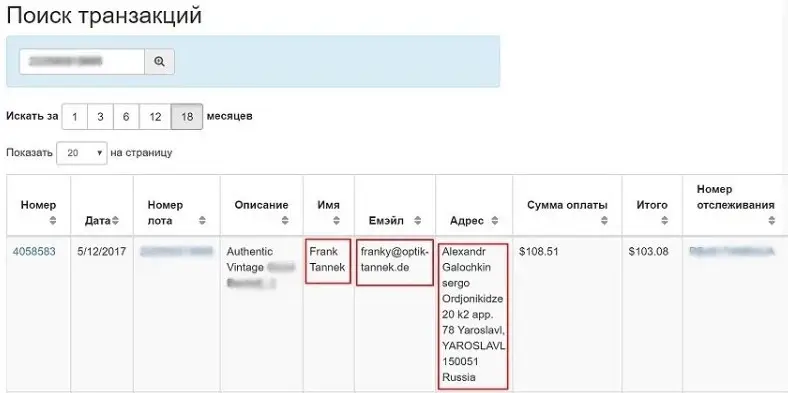
This example shows that the account owner is a resident of a Western country (most likely Germany), and the recipient is a resident of Russia.
Another sign of potential fraud can be the presence of an email address in a country different from the shipping country. In the above example, it is visible that the user’s email is in the German internet zone (.de), and the recipient, again, is from Russia.
The third sign can be the presence of the recipient’s address in a country where PayPal’s jurisdiction either does not apply at all or applies very limited. Usually, these are countries in Africa (especially Somalia), the Middle East (excluding Israel), Asia (excluding China and Japan), Latin America (especially Venezuela), and countries of the former Soviet Union (excluding EU countries).
Each of these signs indicates a possible scam, and the presence of all three signs means that the best option is to decline the transaction and refund the money. It is better to refund the money before a chargeback is opened in PayPal, as the cost of a chargeback in PayPal is $10.00, and neither the PayPal fee nor the Western Bid fee is refunded when returning the money.
Suspicious Payment Checklist
- Check if the account holder’s last name matches the recipient’s last name.
- Assess whether the shipping country makes sense for this customer.
- See if the email domain matches the customer’s country and profile.
- Pay attention to whether the shipment is going to a high-risk country.
- Do not rely solely on positive feedback or an “old” account.
- If several red flags match, do not ship the product automatically.
- In cases of high risk, refund the money before a chargeback is initiated.
HOW TO PROTECT YOURSELF FROM SUCH FRAUD?
Here is a list of necessary actions that will help you avoid fraud:
- Check if the recipient’s surname matches the account holder’s surname. Of course, sometimes people order gifts for each other, but it’s unlikely that the ranch owner in Texas will order an expensive item for a friend in Pakistan. Usually, people have friends and relatives in their own country.
- Close the possibility for others to purchase your lots from countries with low purchasing power. If you do not want to sell exclusively in the USA, Canada, Australia, Japan, Israel, and the European Union, then at least mention in the lot description that you do not accept PayPal payments from buyers from CIS countries (and accept, for example, only through Privat24 or WebMoney).
- Check the domain zone of the buyer’s email. Of course, there are international domains such as gmail.com. However, it would be very suspicious if a person with an American name, for example, John Smith, has an email in the @com.ua or @yandex.ru zone
Remember that a scammer can link a stolen PayPal account to any account, including their personal EBAY account, and even leave you a positive review. Therefore, a positive review does not influence PayPal’s decision in case of a chargeback for a fraudulent transaction.
Expert Opinion
In the case of a suspicious PayPal payment, the biggest mistake is confusing “maybe everything will be fine” with real seller security. If several signs of fraud coincide at the same time, it is safer to refuse the deal before shipping the goods than to fight a chargeback after losing the item.
Editorial summary based on Western Bid article
Frequently Asked Questions
How does the scam scheme with a hacked PayPal account work?
How does the scam scheme with a hacked PayPal account work?
The article clearly explains that the scammer gains access to someone else’s PayPal account, changes the delivery address to theirs, and purchases an item. After that, the legitimate account owner notices the unauthorized payment, contacts the bank, and a chargeback is opened in PayPal. It is very difficult for the seller to win such a case.
What is the most noticeable sign of suspicious payment?
What is the most noticeable sign of suspicious payment?
The most noticeable signal is the mismatch between the account holder’s surname and the recipient’s surname. On the page, this is called the most typical sign of such fraudulent purchase.
Why can a buyer's email also be a risk signal?
Why can a buyer's email also be a risk signal?
Because the email domain zone may not match the delivery country or the buyer’s profile logic. The article provides an example where the user’s email was in the German zone .de, but the recipient was in a different country. It also separately mentions that it looks suspicious when a conditional American has an email in the zone @com.ua or @yandex.ru.
Can the shipping country be a separate indicator of fraud?
Can the shipping country be a separate indicator of fraud?
Yes. The text explicitly states that an additional risk is delivery to countries where PayPal’s jurisdiction either does not operate or operates very restrictively. The article mentions examples such as some countries in Africa, the Middle East, Asia, Latin America, and the post-Soviet space outside the EU.
What to do if a payment has multiple suspicious signs at once?
What to do if a payment has multiple suspicious signs at once?
The page directly recommends refusing the deal and getting a refund if all key risk signals match. It is safer to refund the money before initiating a chargeback than to lose the goods and pay additional fees.
What actions help reduce the risk of such payments?
What actions help reduce the risk of such payments?
The article directly advises verifying the match between the account owner’s last name and the recipient, analyzing the email domain zone, and also limiting or separately regulating the acceptance of payments from high-risk countries. This is a basic check before shipping the product.
What to do next
Start with an internal risk check rule: before sending a high-value or suspicious order, verify the recipient’s name, email, shipping country, and overall purchase logic. One simple checklist before sending often saves much more than dealing with the aftermath of a chargeback.


