Brief Summary
Currently Etsy, eBay, Amazon, Shopify, and other platforms are not obliged to automatically transmit data about Ukrainian sellers to the State Tax Service of Ukraine, because Ukraine is not yet operating within the DAC7/DPI MCAA exchange system.
After the implementation of rules in Ukraine digital platforms will be able to transfer or automatically exchange income data of Ukrainian sellers directly with tax authorities. For sellers, this means: it is advisable to check their tax status, income records, and supporting documents in advance.
The essence in one block
Key point: Currently, there is no automatic data transfer to Ukraine, but the DAC7 model has been created precisely so that platforms report sellers, and tax authorities receive this data automatically once the country joins the relevant mechanism.
Who this article is for
- for sellers on Etsy, eBay, Amazon, Shopify;
- for Ukrainian FOP, individuals, and companies who sell abroad;
- for those who receive payments through Payoneer, Stripe, PayPal, or bank;
- for sellers who want to understand when exactly the tax authorities will be able to see the data and what to do about it in practice.

Comparison: how it works now and what will change after implementation
| Question | Now | After DAC7/DPI approach implementation in Ukraine |
|---|---|---|
| Do platforms automatically transmit data to Ukraine? | No | Yes, through automatic exchange or reporting to the State Tax Service |
| Does this concern Etsy, eBay, Amazon, Shopify? | Currently for Ukraine — no | Yes, if Ukraine becomes a reporting jurisdiction |
| Are all sellers included in reporting? | No | No, small sellers may not meet thresholds |
| Are past years covered automatically? | No | Usually no, the start is from the moment of joining/implementation |
| What does the tax authority see? | Only through specific channels or requests | Seller data, payment amounts, transaction counts, settlement accounts, commissions |
Checklist for Ukrainian Seller
- Determine who legally receives the income: individual, sole proprietor, or LLC.
- Keep records of marketplace, payment provider, and bank statements.
- Separate documentation of commissions, refunds, order cancellations, and customer taxes.
- Check how your tax base is determined.
- Prepare a response logic to questions: where the funds come from, through which platform, and in which status you operate.
About the implementation of DAC 7 and Data Exchange for Digital Platforms in Ukraine
DAC 7 and platforms. EU Directive 2021/514 (DAC 7) requires digital platform operators to collect and report to tax authorities data on the income of sellers operating through their platforms. These rules cover platforms that allow users (both individuals and companies) to sell goods, provide services, lease property, etc. (so-called “relevant activities”). Scope of application: DAC7 applies to platform operators registered or with offices in the EU, as well as to non-EU operators if they conduct business activities in the EU (for example, having sellers who are EU residents).
According to DAC7 reporting is mandatory for sellers who are tax residents of EU countries or who rent out real estate in the EU. Exceptions are made for certain categories, including government agencies, companies listed on stock exchanges, and small sellers: if fewer than 30 transactions are made through the platform per year and the total fee does not exceed €2000, information about such a seller is not provided. Therefore, very minor activity on the platform is not covered by reporting. All other sellers (including sole proprietors and regular individuals) are considered reportable if they are residents of jurisdictions participating in the exchange and conduct activities through the platform.
DPI MCAA and data exchange. For automatic international data exchange, a Multilateral Competent Authority Agreement on automatic exchange of information about income received through digital platforms (DPI MCAA) has been established. It allows tax authorities of different countries to automatically exchange reporting information collected by platforms annually. As of April 2025, 29-30 jurisdictions have joined DPI MCAA (primarily EU countries, as well as, for example, Canada, New Zealand, Norway, etc.). Ukraine is currently not a participant, but is actively preparing to join. The prerequisites are the implementation of OECD model rules for platforms and DAC7 provisions into national legislation.
Resonant Bill No. 13232 (dated 30.04.2025), also known as “OLX Tax Law”. What is it? The Ukrainian government approved the draft law on April 29, 2025, which introduces provisions for automatic exchange of information about income from digital platforms into the Tax Code. This bill aims to add a new article to the Ukrainian Tax Code concerning international automatic exchange of such information, specify due diligence requirements for platform users, identify reportable sellers, and submit reports to the State Tax Service of Ukraine. Ukrainian legislation is effectively harmonized with European standards, fulfilling the IMF’s structural benchmark. After passing this law and joining DPI MCAA, Ukraine will be able to receive from partners information about the incomes of its tax residents earned through foreign platforms, and will also be able to provide data on non-residents earning through Ukrainian platforms.
Are Etsy and eBay required to report Ukrainian users to the Ukrainian tax authorities?

Current status (before Ukraine’s accession). Currently no, these platforms do not have an automatic obligation to share information with Ukrainian authorities. Under DAC7 rules, Etsy, eBay, and other platforms currently only report about sellers who are residents of EU countries or transactions involving EU assets. Ukrainian sellers are not covered by the concept of “reportable seller” within the purely European exchange, as Ukraine is not an EU member or participant in the agreement as of 2023-2024. Practically, this means that although operators like Etsy / eBay do collect certain data about all sellers, they are not obliged to transmit data about Ukrainian residents to any tax authority (except in cases of individual queries). For example, the first data exchange under DAC7 between EU countries took place in February 2024 and concerned income for 2023 — none of this data was transmitted to Ukraine, as there were no legal grounds to do so.
Expected changes (after implementation and accession). Yes, an obligation will arise. After passing the mentioned bill and accession to DPI MCAA platforms will be required to report about Ukrainian sellers. Ukraine, having implemented the model rules, will become a “reporting jurisdiction” for platforms just like EU countries. This means that operators like Etsy and eBay will have to either:
- Include Ukrainian residents in their report to the competent authority as part of international exchange, and then the Ukrainian tax authority will automatically receive these details through the DPI MCAA channel;
- Or directly report to the State Tax Service of Ukraine, if they have such an obligation under Ukrainian law (for example, in case of registering a permanent establishment or choosing Ukraine as a reporting jurisdiction). Bill №13232 imposes on platform operators the responsibilities of tax agents in Ukraine, which includes submitting reports to the State Tax Service about the liable sellers. In other words, when Ukraine becomes a participant in the system, platforms will have no choice — transmitting information will become their duty, not just a right or a gesture of goodwill. This is confirmed by the requirement that participating countries include effective sanctions for non-compliance by platforms with these norms. EU countries already impose fines up to tens of thousands of euros for DAC7 reporting violations; similarly, Ukrainian legislation is likely to establish sanctions against operators that do not provide data.
Completeness of reporting: all data and everyone?. The volume of information that platforms must provide is quite detailed: seller identification data (full name / company name, address, TIN / VAT number), account number for payments, total paid income for the period, number of transactions, withholdings of commissions or taxes, etc. However, as noted, not all sellers are subject to reporting. A platform will not report about a seller if their activity does not cross certain thresholds: fewer than 30 sales and ≤ €2000 annually. Thus, if a Ukrainian user only occasionally sells something via Etsy / eBay for a modest amount, this data may not be transmitted. All more active sellers (including entrepreneurs and individuals with significant turnover) will be covered by full reporting — without any exceptions, except for the mentioned threshold and specific cases (for example, if the seller is a government agency or a public company, which is unlikely in practice for Etsy / eBay).
Obligation vs. right. In the context of international exchange, this is precisely an obligation. Platforms will not have discretionary power to decide whether to transmit data — they will be obliged to do so automatically. The only flexibility for non-EU-resident platforms is to choose a single country for registration and reporting (the EU operates on a “single window” principle for operators outside the EU). For example, a non-European operator (like Etsy Inc., based in the USA) can register in one EU country, report there about all required sellers, and that information will then be automatically distributed to other countries. After Ukraine joins the MCAA, foreign platforms with Ukrainian sellers will be able to transmit data through already established channels. The Ukrainian bill itself provides for operators to submit reports directly to the DPS Ukraine. Thus, for Etsy, eBay, and similar companies, compliance with Ukrainian requirements will become a mandatory condition to continue working with Ukrainian users.
Exchange type: automatic or on request? What does Ukraine need?

Automatic Exchange. The system provided is automatic. This means that once a year, tax authorities of different countries exchange data arrays without individual requests concerning each taxpayer. DAC7 establishes an annual cycle: platforms submit data for the previous calendar year by January 31, and tax authorities exchange them by the end of the following month (in the EU – by the end of February). At the global level, the MCAA similarly provides for an annual automatic exchange using a standard XML format (DPI XML Schema). Conditionally, when Ukraine joins, it can initially receive data automatically for the year in which the participation comes into force. (For example, if the agreement is ratified and implementation is completed in 2025, Ukraine would receive data for 2025 in 2026).
Conditions for Ukraine. For the exchange to start working, Ukraine must take the following steps:
- Implement necessary rules into legislation. As mentioned, the temporarily withdrawn draft law №13232 is intended to introduce OECD model rules and DAC7 provisions into the Tax Code. These include the concepts of “platform operator,” “reportable seller,” the procedure for due diligence checks on sellers, reporting procedures and deadlines, etc. Without these norms, the Ukrainian tax authorities would simply not have the right to collect or exchange relevant information.
- Join the multilateral agreement (DPI MCAA). It is necessary to sign and ratify the MCAA — only then will other jurisdictions be able to lawfully transfer data to us, and we to them. Ukraine has already officially announced its intention to join and is working on it. In fact, the implementation of the model rules is a condition for accession, after which Ukraine will be technically integrated into the automatic exchange system.
- Ensure technical and institutional readiness. It is necessary to set up IT systems for data reception/transmission in the OECD standard (XML Schema), ensure information protection and confidentiality. Work has already been done: OECD has developed a unified format used both for DPI MCAA and DAC7 exchanges. Ukraine, preparing for CRS (financial information exchange), successfully completed security assessments and set up the necessary infrastructure by 2024. This will also facilitate platform data exchanges.
Exchange status after joining. After these conditions are met, the data exchange will become automatic. The Ukrainian VAT authority will regularly receive information from partners about the income of Ukrainians earned through foreign platforms, without additional requests. Importantly, DPI MCAA allows both bilateral and non-reciprocal exchange — meaning a jurisdiction can receive information even if it does not yet provide it itself (e.g., during a transitional period). However, Ukraine plans to be a full participant and also provide data on non-residents earning via Ukrainian platforms, ensuring reciprocity.
Right or obligation for Ukraine to receive data. From an international law perspective, joining the MCAA grants the right to obtain information but also imposes the obligation to send it to partners. For Ukrainian tax authorities, this will likely be an opportunity they will certainly utilize. That is, the Ukrainian VAT authority will have the ability to automatically receive necessary data and be obliged to protect and properly use it. If data does not arrive from a partner country (for example, the platform is registered in a country that has not signed the MCAA or has not completed the procedures), then Ukraine can request information through bilateral conventions. But this is a different (non-systemic) mechanism.
Will Ukraine receive data on the past years of Ukrainians' work on the platforms?
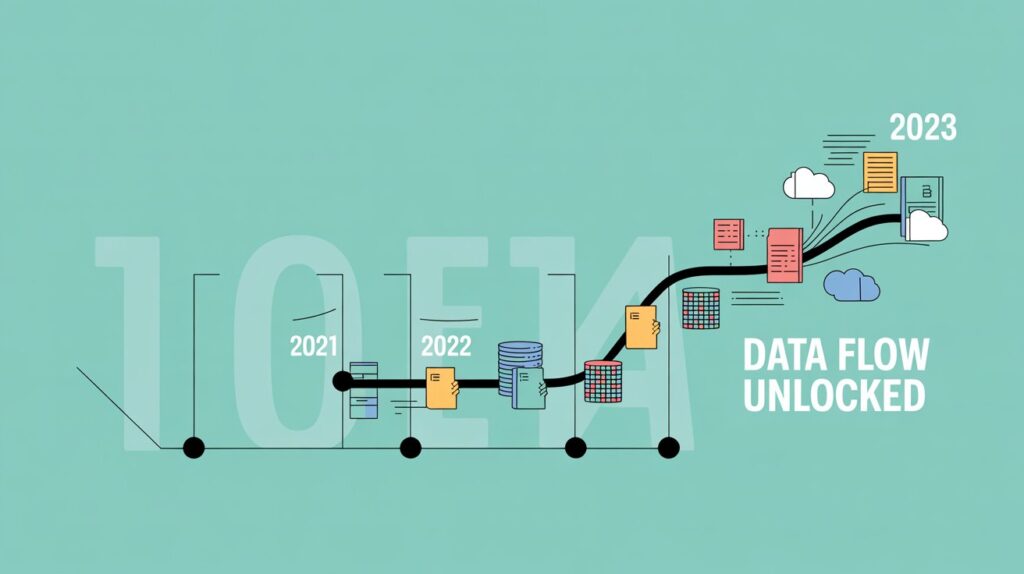
Automatic exchange does not cover the past periods before accession. The income information exchange system between platforms generally has no retrospective effect. DAC7 has been effective since 2023 (the first reporting period is 2023), and even EU countries do not exchange data for previous years. Similarly, when Ukraine joins, it will start receiving information from the year of accession (or the following year). Income information of Ukrainian sellers for previous years (before accession) will not be automatically provided. This is because:
- previously, platforms might not have collected complete tax data about our residents (there was no requirement);
- other countries lacked legal grounds to share such information with Ukraine.
For example, if a Ukrainian traded on Etsy in 2021-2022 and did not declare income, then as of now, these historical data are available to the Ukrainian tax authorities only through individual investigation. Ukraine could request information via exchange mechanisms under tax treaties or through international legal assistance, but this is a non-systematic process that requires justification (i.e., suspicion of tax evasion). The right to request information for past periods in Ukraine is formally available (within the framework of double taxation avoidance agreements and exchange of tax information upon request). However, there is no obligation for counterparties to provide retrospective data — they provide only what is included in the automatic exchange from its starting date.
In other words, after the program starts, the Ukrainian State Tax Service will see income through platforms for future tax periods. Regarding previous years, mass “tax reassessments” based on new data are not expected. It is possible only to analyze the information obtained from the initial reports, and if significant sellers are found who previously did not declare income, the tax authorities may initiate audits for past years. But this would be an implementation of control powers, not a direct action of the agreement. Currently, there are no indications in public sources that Ukraine will agree to receive historical data for periods before accession — the focus is on prospective exchange.
Summary: Ukrainian tax authorities will have the opportunity to receive information about Ukrainian income on platforms, starting from the year of exchange implementation, but not earlier. For previous periods — only in case of separate actions (requests, audits). Therefore, for those sellers who have not declared their earnings in the past, the state currently offers to voluntarily legalize this in advance, including through the use of the new preferential regime of 5% (see below).
Taxation of Ukrainian entrepreneur's income from sales through platforms
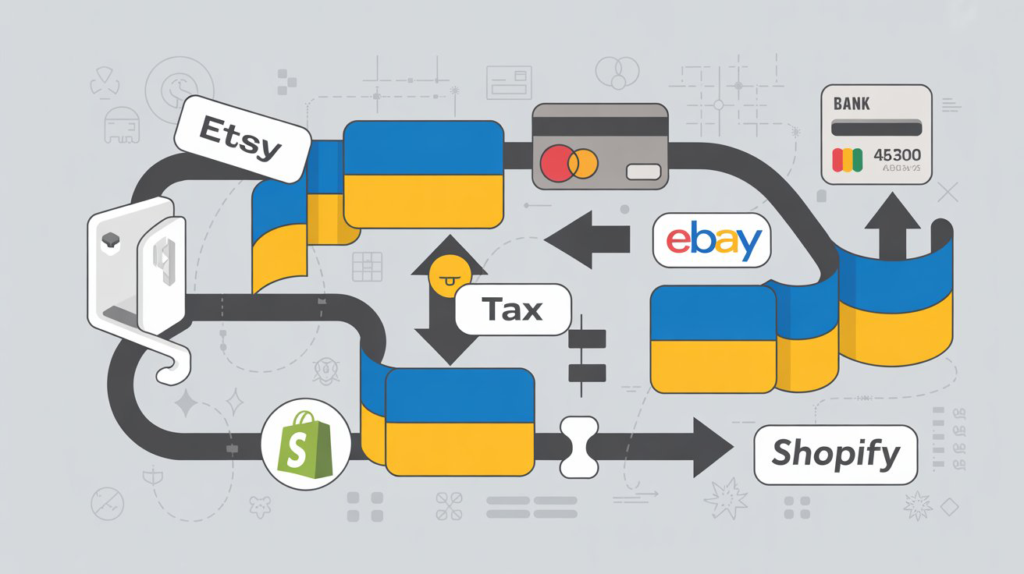
Let’s consider, from which sales amount and taxable base a Ukrainian entrepreneur must pay taxes when trading on Etsy, eBay, Shopify, etc. The situation depends on the organizational and legal status of the seller and the taxation system:
- An individual entrepreneur (FOP) on the simplified system – group 2 or group 3 of the single tax.
- FOP or other individual on the general system – pays taxes on net profit.
- Limited Liability Company (LLC) – as a legal entity, or on the single tax (group 3 for legal entities), or on the general system (profit tax).
Let’s analyze both cases in detail.
Individual entrepreneur on a single tax (group 2 or 3)
Rates and Limits. Group 3 of the single tax—most common for online trade—implies a 5% of income rate (assuming non-registration for VAT purposes). The tax is paid on total revenue without deducting expenses. Group 2 pays a fixed rate (approximately 1340-1600 UAH per month as of 2025) regardless of turnover, but with an annual income limit of about 6.7 million UAH. That is, Group 2 allows paying a fixed tax amount in advance, whereas Group 3 is a percentage of turnover.
Tax base: From the full amount paid by the buyer or the amount received by the entrepreneur? – It is crucial for sole proprietors to understand that the object of taxation is income received in cash during the period. That is, the tax is levied on the amount of funds the individual entrepreneur (FOP) actually received into their account or in cash. If a buyer paid $100 for a product, but the platform withheld a commission and taxes and transferred, say, $90 to the entrepreneur, then the taxable income is $90. The FOP does not include in income sums that did not come directly to them (e.g., VAT or other taxes that the platform independently deducted from the buyer and transferred abroad). Similarly, marketplace fees/commissions effectively reduce the amount received by the entrepreneur, so they pay the single tax on the net settlement from the platform. From the DAC7 “reward” perspective, it refers exactly to the net amount after commissions or taxes withheld by the platform — which coincides with what the FOP actually receives.
Example: A buyer paid $120 on Etsy for a product, of which $20 is EU VAT, and $5 is Etsy commission. The seller (FOP) received $95 into their account. These $95 are subject to taxation as their income. The $20 VAT was not their income, and the $5 was paid as a platform service — but since a Group 3 FOP cannot deduct expenses, only the amount they actually received ($95) will go into income.
Returns of goods and funds. If a sale is canceled and the money refunded to the buyer, this turnover is not included in the FOP’s income. The Tax Code explicitly states that prepayments / advances refunded to the buyer due to product returns or contract termination are not considered income of the sole proprietor. Practically, this means that when a refund occurs, the entrepreneur can exclude this amount from taxable income. If the refund happened in the same quarter as the sale, the entrepreneur simply does not include this revenue in the declaration (or immediately subtracts it). If funds were received in one quarter and refunded in the next, the tax authority advises submitting a correction declaration for the period in which the income was originally reported. Although this introduces additional bureaucracy, it is important that the tax is ultimately paid only on the amounts remaining with the entrepreneur after all settlements with clients. Therefore, refunds to clients reduce the tax base (are not taxed).
Gross income or profit? Under simplified taxation system, expenses are not taken into account. The FOP Group 3 pays 5% precisely from revenue (gross income), not profit. This means that even if, from the aforementioned $95 received, the entrepreneur had expenses (cost of goods, delivery, advertising, etc.), they do not reduce the amount of the single tax. The single tax is a “turnover tax.” Similarly, an FOP of Group 2 pays a fixed amount regardless of expenses or margin. At the same time, simplified entrepreneurs are exempt from profit tax, VAT (at 5%), maintain minimal reporting, etc., which compensates for the absence of expense deduction in the tax calculation.
Taxation of small sums. Beginners on platforms often ask: “Do I have to pay taxes if I only sold one thing for a small amount?” Legally, yes, you do if this income is from entrepreneurial activity. In practice, a Group 3 FOP may not have any personal income tax or unified tax obligation if they had no income in the quarter (Group 3 pays only on actual received income). A Group 2 FOP pays their fixed fee even for months without sales (unless on leave). However, Draft Law No. 13232 introduces an incentive for very small individual sellers: if they have no more than 3 sales per year totaling up to €2000, they are allowed not to open a separate “entrepreneurial” bank account and can use their personal account — acting as non-entrepreneurs. But even in such cases, the tax rate will be 5% of the received income. The government thus provides an opportunity for occasional sellers to easily meet tax obligations (the platform acts as a tax agent and pays 5% on sales).
New 5% mode for individuals. In the context of the future, it’s worth mentioning that draft law proposes a separate preferential tax regime on income received through platforms for physical persons-residents who are not registered as FOP. Under certain conditions (a special account for this activity, no hired employees, not exceeding an annual income of about 6.7 million UAH, not trading excisable goods, etc.), such individuals will be able to pay only 5% personal income tax from platform revenues. The obligation to withhold this tax falls on the platform operator. Essentially, this is an alternative to registering as an FOP: since the platform will already provide information on incomes, the state suggests immediately withholding 5% — the same amount a single tax payer would pay. This regime aims to simplify voluntary tax compliance for non-entrepreneurial sellers and bring them out of the shadow economy. For already registered FOPs (Group 3, 5% rate), essentially nothing will change — they still pay the same 5%, but independently. However, if an FOP is a “self-employed individual,” this new regime does not apply (condition — “not self-employed”). Thus, entrepreneurs will remain under their current rules, while unregistered sellers will have a chance to easily legitimize their income with a minimal rate via the platform’s mechanism.
Military levy and ESV. Do not forget that individuals in Ukraine also pay 5% military levy on their income. FOP single taxpayers were previously exempt from the military levy, but from 2023 it was reinstated: for Group 3 — 1% of turnover (essentially, on top of the full 5%, totaling about 6.5%), for Groups 1-2 a fixed monthly payment (~800 UAH). Draft Law on 5% personal income tax probably does not cancel the military levy, so the total burden for the platform seller can be about 6.5%. The Single Social Contribution (ESV) is paid by all entrepreneurs obligatorily, regardless of the system (22% of the minimum wage per month). For an individual not registered as an FOP, income from sales is not a base for ESV, so the new 5% regime does not envisage paying social contributions (which is a plus, but note that such persons do not accrue pension rights during these periods).
Therefore, a Ukrainian entrepreneur (FOP or not) must pay tax from the first hryvnia/dollar earned. For simplified taxpayers — 5% (or fixed payment), calculated from the total amount received into their account for the product/service. Neither taxes paid abroad by the buyer nor service commissions increase the taxable income—they effectively reduce the amount reaching the entrepreneur. But expenses are not deducted from the base (for the single tax). The tax is paid on the total income for the period (quarter for Group 3 EUP), not on each transaction individually. Refunds to buyers are excluded from income, and tax on them is not paid (though previous declarations may need adjustments if the period is closed).
LLC (or sole proprietor/individual on the general system)
General system (profit tax / income). If the seller works as LLC or another legal entity under the traditional taxation system, or as a sole proprietorship under the general regime, then taxation occurs from net profit (income minus expenses). For legal entities, the main tax is 18% profit tax. For individuals on the general system, it is 18% Personal Income Tax + 5% Military Fee from the taxable income. The base is determined by accounting rules: revenue from sales minus documented expenses related to this activity.
In the case of online sales through platforms, all direct costs can be included in expenses: cost of goods, marketplace commission, payment provider fee (e.g., PayPal / Payoneer), delivery, advertising, etc. – provided they are properly documented. Therefore, LLC pays 18% only on the net profit remaining from sales, not on the total revenue. For sole proprietors on the general system, it effectively amounts to the same, only instead of profit tax, they pay PIT and military fee on net income.
Example: LLC sold goods for $100, cost of goods $50, Etsy commission $10, delivery $5 – profit amounts to $35. Profit tax will be approximately $6.3 (18% of $35). A sole proprietor on the general system in a similar situation would pay approximately $6.3 PIT + about $0.5 military fee (total about $6.8) from the same profit of $35.
What about small sales? On the general system, there is no minimum income threshold – formally, any profit should be declared and taxed. But if the activity is one-time or irregular, people often do not register as entrepreneurs. This is legally wrong (income of individuals from sales of goods is also subject to PIT). However, the state could only tax one-time sales if they are detected. With the new regime of 5% and automatic information exchange, even small sellers will come into the spotlight – but their lives will be made easier by offering to pay 5% through the platform. If someone wishes to stay on the general system (for example, a large seller with expenses >80% or needing VAT status), they can do so – then the platform will likely not withhold 5%, but will provide data to the tax authorities, and the company / entrepreneur will report themselves. The bill explicitly states that 5% is a preferential rate for resident payers who meet certain criteria. If the resident does not meet these (e.g., LLC or sole proprietor with employees), they simply operate under the general taxation rules for their status.
Frequency of reporting. LLC reports quarterly or yearly on profit tax (depending on size), sole proprietors on the general system – once a year with PIT. All sales for the period are considered, with net profit summed up, including returns (adjusted income / expenses). Return of goods for legal entities is reflected by reversing income and expenses, thus reducing that period’s profit. For sole proprietors under the general system, a return means they did not receive income, or if they received it and later returned it the following year – they can show a negative result in the year of return and thus avoid paying on that amount (or submit an adjustment for the previous year if they have already paid). In any case, as with single tax payers, refunds are not taxed in the end – they are either not included in income or are excluded during adjustments.
Conclusion: From the tax base perspective: sole proprietors on the 2nd and 3rd groups pay tax on the total amount of proceeds (revenue), without deducting expenses. But practically, this revenue is the net payment from the platform, already after deductions of commissions and taxes withheld by the platform from the buyer. LLC and general system individuals pay from profit, so they can deduct marketplace commissions, cost of goods, and other expenses. Frequency – the tax is calculated on the aggregate financial result for the period, not from each transaction separately (although for single tax payers, 5% from each hryvnia of income is the same as 5% from the quarterly sum). Refunds to buyers, canceled sales are not subject to taxation – they are excluded from income according to the norms of the Tax Code.
Payoneer and its role in reporting and taxation
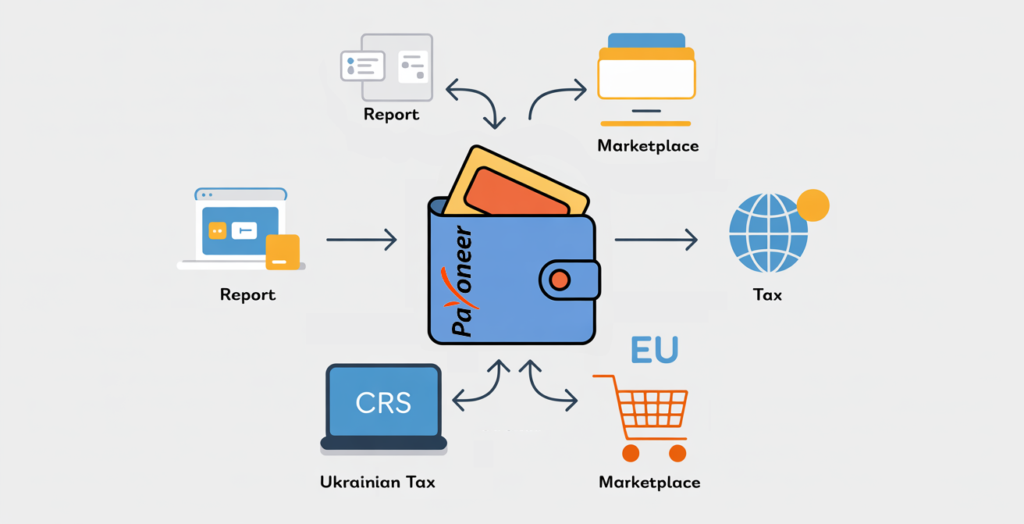
Does Payoneer have to report? Payoneer is a payment system (a provider of money transfers and e-wallets), not a trading platform that connects sellers and buyers. The definition of “digital platform” under DAC7 / OECD context clearly excludes software that exclusively processes payments or just advertising boards without transactions. Therefore, Payoneer is not considered a “digital platform operator” for these rules. It does not organize sales but only transfers funds earned on other platforms to user accounts. Hence, neither the DAC7 directive nor the model rules require Payoneer to report income to tax authorities.
Financial Information Exchange (CRS). At the same time, Payoneer (like other payment services, banks, card issuers) falls under the global standard for automatic exchange of financial account information (CRS – Common Reporting Standard). Ukraine implemented CRS in 2023 and, from September 2024, has been automatically sharing data on financial accounts with over 50 countries. If a Ukrainian’s Payoneer account is opened in a jurisdiction that is a CRS participant (for example, Payoneer has a subsidiary in the EU or another participating country), then information about that account – balance, transactions, etc. – may be transmitted to the Ukrainian State Tax Service within CRS. This is a separate mechanism from DAC7: it concerns financial accounts, not platform income. As a result, Ukrainian tax authorities may potentially know about the existence of a Payoneer account in a person’s name and about the movement of funds on it (as part of financial reporting). However, these data will not include details on what exactly the funds were for – only the balance and total amounts for the year.
Does Payoneer become a tax agent? No, Ukrainian law does not impose tax agent responsibilities on payment systems for these incomes. The role of a tax agent, according to the draft law, is assigned to platform operators (such as Etsy, eBay, etc.). Payoneer simply performs transfers. Therefore, it will not withhold a 5% tax from your income – this must be done by the platform before sending funds (or reported to the tax authorities to control self-employed taxpayers’ payments).
Taxation of income transferred to Payoneer. For entrepreneurs or individuals, it makes no difference through which payment service the money was received. From the perspective of Ukrainian tax law, the important fact is the receipt of income. If a Ukrainian earns $100 on Etsy and it “sits” on the Payoneer account, this income is considered already received (regardless of whether they transferred it to their Ukrainian bank or not). Sole proprietors registered as a single taxpayer are obliged to reflect income on the date it is credited to their entrepreneurial account. There’s a nuance: Payoneer is not a bank but an electronic wallet. Some sole proprietors open a foreign currency account in a Ukrainian bank and link it to Payoneer for receiving payments; others use a Payoneer card and may never transfer money into Ukraine. But this does not exempt from taxation – residents must declare global income, regardless of where the funds are stored. In practice, many declare income when it hits their Ukrainian account (during currency receipt, banks require documents, which “reveal” the proceeds). With the introduction of automatic exchange, the tax authorities will also know about foreign accounts, so it’s advisable to consider money received on Payoneer as taxable income at the moment funds come under your control.
Summary regarding Payoneer: this service is not obliged to submit reports under DAC7 / MCAA since it is not a marketplace. Meanwhile, information about Payoneer accounts of Ukrainian residents may be transferred to Ukraine via CRS (financial exchange), but without transaction-level detail. Concerning taxes, nothing changes for sellers: income from sales is taxed (as calculated above), regardless of whether it was received on Payoneer, PayPal, or a bank account. Expenses for Payoneer commissions (currency conversion, annual card maintenance, etc.) cannot be deducted by sole proprietors on a simplified system; but businesses on the general system can classify them as expenses, thereby reducing taxable profit.
Shopify Platform: responsibilities and taxation
Feature of Shopify. Shopify is a somewhat different format: it is a platform that allows sellers to create their own online store. It does not aggregate all products on a common marketplace like Etsy or eBay, but essentially it is a digital platform through which sellers (merchants) find buyers (who visit the created stores). That is, Shopify also falls under the definition of software that “enables sellers to connect with users to carry out relevant activities (selling goods).” Therefore, in the context of DAC7 / OECD rules, Shopify is a platform operator, with similar obligations.
Will Shopify report Ukrainian sellers? Yes, after Ukraine joins the system — it must report. Currently, Shopify, as a Canadian company, has already prepared for global requirements: Canada has signed the DPI MCAA and plans to exchange information. Moreover, Shopify operates in the EU (has clients in Europe), so it is subject to DAC7: as a non-resident operator with sellers in the EU, Shopify was obliged to register in one of the EU countries and report on European sellers. Accordingly, when Ukraine joins, Shopify will similarly need to provide data on Ukrainian sellers. The mechanism could be either through the Canadian tax authority (CRA) — if Canada implements the rules and includes Ukraine in the exchange list, — or through an European hub (if Shopify decides to include Ukrainians in its report, for example, in Ireland, which then transmits it to us via MCAA). In any case, Shopify will not be able to ignore Ukrainian merchants. This will be part of its overall reporting obligation. Exceptions are the same: small sellers (≤€2 000 per year, <30 orders) may not be included in the report, but the rest will be.
Is reporting in full and mandatory? Reporting for Shopify will be as mandatory as for others. Even though Shopify mainly does not process payments (sellers can connect third-party gateways, e.g., Stripe), — the reporting obligation concerns the platform facilitating transactions, not the payment provider. Therefore, Shopify, knowing the sales volumes of merchants through their stores, must share this information. Data collection is already in place, as Shopify sends sellers annual sales reports, and to comply with DAC7, they had to verify sellers’ tax IDs, addresses, etc. The volume will be complete, except for the already mentioned thresholds.
It is worth noting that withholding taxes will most likely not be performed by Shopify. Unlike Etsy, Shopify does not act as a payment intermediary (unless the merchant uses Shopify Payments option). Buyers pay directly to the store (via integrated acquiring). Therefore, Shopify cannot technically fulfill the role of tax agent (e.g., deduct 5% PDI from Ukrainians) in many cases. Accordingly, it is more relevant for Ukrainian tax authorities to receive information: they will get data on the sellers’ revenue and will be able to monitor tax payments directly from the sellers. If the seller is an individual without FOP status, the tax authority will know about their income and can demand payment of 18% (or suggest switching to a 5% regime through self-declaration or other means). If the seller is an FOP, the data will be provided and reconciled with their tax declarations. It can be anticipated that future legislation will clarify the mechanism: perhaps, for platforms that do not make payments to sellers, the obligation of the tax agent will be nominal (they only report data, not withhold tax). In any case, the right of Ukraine to access information extends to such platforms — effectively, Shopify will transfer everything, and the tax payment will be resolved on the side of the State Fiscal Service and the payer.
Automatic exchange for Shopify. Likewise, the exchange will be automatic through MCAA. Shopify will provide a report either to the Canadian tax authority or to another designated authority, and Ukraine will receive the data from that competent entity. Ukraine only needs to participate in the agreement — a separate bilateral arrangement with Canada is not required, since MCAA is multilateral (Canada is already a signatory). If Shopify reports through an European jurisdiction, then under OECD rules, this data can still be transmitted to Ukraine (within the framework of MCAA, which the EU also supports).
Data for past years on Shopify. The situation is similar: before Ukraine’s accession, neither Canada nor other countries shared such data with us. Shopify might have stored historical sales, but they will not be automatically transferred “retroactively.” The Ukrainian tax authority, upon receiving the first reports, will, of course, have a picture of the seller’s turnover for the previous year (e.g., if the launch occurs in 2025, they will get data for 2025). But, for example, for 2024, we will not receive information from Shopify if Ukraine was not a participant in the agreement in 2024. Therefore, there are no special retro mechanisms — only indirectly, through control and verification, as described earlier.
Taxation for Shopify sellers. It does not differ from what was considered for Etsy / eBay sellers. If the merchant is an FOP on a single tax, they pay 5% of revenue (in hryvnias) for their sales, as with any other. If they are a LLC, they pay corporate tax on the net financial result. If an individual without status — they are formally required to declare 18% PDI + 1.5% Military tax. In practice, many small sellers have not done this so far; but with data sharing beginning, it becomes risky. Therefore, they should either register as FOP or rely on the platform (in the future) to help pay 5%. Again, since Shopify does not transfer money directly to the seller but only creates a store, the tax agent function for it is conditional. Perhaps Shopify will not withhold anything, but full transparency will make evasion practically impossible.
Payoneer for Shopify. As with Etsy, many Ukrainian Shopify sellers use Payoneer / Stripe to receive payments from clients. This aspect has already been addressed: payment providers do not report under DAC7, but account data may be transmitted through CRS. If funds go directly to a Ukrainian bank account — they are already monitored (banks transmit financial monitoring data about currency inflows). The state will be aware either from sales data (Shopify will provide sales volume), or from financial institutions (banks/payment systems will report received funds).
Conclusions: current and future obligations, all scenarios
- Current situation: eBay, Etsy, Shopify, and other foreign platforms are not obliged to automatically report to the Ukrainian tax authorities about Ukrainian users – Ukraine is not yet part of the DAC7 / DPI system. Information about Ukrainian income on these platforms is only received by the tax authorities if they request it themselves or if the taxpayer voluntarily declares it. Payoneer does not transmit payment data (except upon request from law enforcement). Ukrainian entrepreneurs, as before, must declare income from foreign sales independently. Sole proprietors with a single income pay 5% of revenue, general-system entrepreneurs / LLCs – 18% of profit, individuals – 19.5% of net income (which usually does not happen in reality without oversight).
- Future obligations (after implementation): Platforms will be required to provide Ukraine with information on sales of Ukrainian users automatically. Exchange will take place annually through multilateral channels. Etsy, eBay, etc., will either report directly to the State Tax Service of Ukraine or through the tax authorities of their countries – but ultimately the data will reach Ukraine. This concerns most sellers, except very small ones (≤€2,000 annual income), who are not subject to reporting. The obligation for platforms will be enshrined in law – non-compliance will be penalized with fines. Payoneer and similar payment services are not covered by this law (they are not “platforms” by definition), so they will not report directly. However, the tax authorities may access information about Ukrainian accounts in these systems through other agreements (CRS).
- Automatic exchange vs. requests: Once Ukraine joins MCAA, exchange will become automatic – no requests needed, data will arrive annually for each reporting seller. Ukraine must complete the implementation of the rules and technically prepare for the exchange to start. Until then, the tax authorities may only act through individual requests (practice is limited). After launch – data arrays will be continuously accessible, dramatically increasing transparency.
- Retrospective: Automatic historical data are not exchanged – neither the EU nor OECD foresee retroactivity. The first data Ukraine will receive is for the year of accession. For previous years, the tax authorities can only selectively request information if they suspect large unpaid sums. But there will be no mass transfer of archival data. For taxpayers, this means forgiveness of past omissions is conditional: if you did not declare income before, the state will not automatically have reports about it, but it can respond to the first automatic report by comparing it with your previous filings.
- Taxation of income: Ukrainian sellers on Etsy / eBay / Shopify must pay taxes on their earnings. For sole proprietors – 5% of the amount they received in their account (total turnover per quarter). Neither platform fees nor taxes paid by buyers abroad (such as VAT) are added on top – they are effectively paid from the net transfer. Expenses (cost of goods, advertising, etc.) do not matter for sole proprietors – tax from gross income. Refunds to buyers are not included in taxable income. Group 2 sole proprietors pay a fixed (~UAH 1,600/month) until the turnover limit of ~UAH 6.7 million, meaning the tax covers all their sales (including the first hryvnia). Sole proprietors / LLCs on the general system pay 18% profit tax (minus military levy for individuals), so they can deduct marketplace commissions, Payoneer fees, costs of goods and delivery from income – tax is only on what remains as profit. Individuals without entrepreneur status would have to pay 19.5% from net income, but with new rules, they are offered an alternative – a 5% payment through the platform under a preferential regime (which is much simpler and more favorable).
- Payoneer and Shopify – summary on “the same questions”: Payoneer will not have a direct obligation to report your income to the Ukrainian tax authorities because it is not a platform operator. But through CRS, the Ukrainian tax authorities could already receive information about your Payoneer account and fund movements from 2024 if Payoneer cooperates with European banks (Payoneer EU). That is, your financial activity is not hidden from the tax authorities. Taxation of funds on Payoneer is no different: they belong to you as business income and must be declared along with any other. Shopify, as a platform for selling goods, will have the same obligations as Etsy / eBay – collect information about sellers and turnover and transfer it within international exchange. This will become a mandatory requirement after Ukraine enters into the agreement. The exchange for Shopify is also automatic. Shopify probably will not withhold taxes (since it does not process payments), but it will provide data, and the tax authorities will ensure payment through the sellers themselves. Past years on Shopify will not be automatically disclosed – only future data. Sales taxes via Shopify are paid similarly: either 5% of turnover (simplified), or 18% of profit (general), or 5% via the new regime for individuals – depending on the seller’s status. Payments passing through Stripe / Payoneer to the seller are considered their income, from which tax is calculated (expenses are only considered on the general system).
In simple terms, all online sellers who are residents of Ukraine will be “flagged” to the tax authorities. Platforms will provide information, and if taxes on these incomes are not paid, the tax authorities will notice sooner or later. The state offers sufficiently lenient taxation conditions (5% without bureaucracy) to encourage voluntary compliance. Therefore, it is advisable to already evaluate your sales volumes and choose the optimal form – a sole proprietor under the single tax or just an individual under 5% via the platform – so that all options for fulfilling tax obligations are covered and future problems are avoided.
It should also be understood that this article is only the author’s view of the probable development of events.
Sources:
- Ministry of Finance of Ukraine – regarding the implementation of international exchange of information on income from digital platforms.
- OECD & EU DAC7 – about platform operators’ obligation to report sellers’ income; criteria for accountable sellers and exemptions.
- Draft Law No13232 – provisions on a 5% personal income tax rate, tax agents-platforms, and criteria for a preferential regime.
- Tax Code of Ukraine – definition of income for sole proprietors and exclusion of amounts refunded to buyers from income.
- Legaltax.pro, etc. – taxation regimes for sole proprietors (groups 2,3) and the general system; rates and limits.
- BDO, PwC reviews – explanations of DAC7 for platforms (concept of platform, single window for registration, reporting deadlines, and sanctions).
- SFA – notification of the launch of CRS financial information exchange in 2024.
- Ministry of Finance of Ukraine
- DAC 7: The new digital platform reporting rules
- DAC7 – European Commission
- Model Reporting Rules for Digital Platforms | OECD
- Multilateral Competent Authority Agreement on Automatic Exchange of Information on Income Derived Through Digital Platforms – Wikipedia
- Signatories of the Multilateral Competent Authority Agreement on Automatic Exchange of Information on Income Derived Through Digital Platforms
- What is DAC7? – BDO
- Ministry of Finance of Ukraine
- State Tax Service successfully implemented the first international automatic exchange of information according to the CRS Standard
- [PDF] The Latest on BEPS and Beyond – EY Global Tax News
- Choosing a taxation system for sole entrepreneurs in 2025: comparisons and strategies
- General taxation system and sole proprietors in 2025
- How sole proprietors-«single taxpayers» should declare refunded funds to buyers?
Expert Opinion
For Ukrainian sellers, the main risk is not the news about DAC7 itself, but that data on sales, payments, and tax status are gradually integrated into one control system. Therefore, those who prepare accounting and documents in advance for the launch of automatic exchange will have an advantage.
Frequently Asked Questions
Do Etsy, eBay, Amazon, or Shopify currently share data about Ukrainian sellers with the State Tax Service of Ukraine?
Do Etsy, eBay, Amazon, or Shopify currently share data about Ukrainian sellers with the State Tax Service of Ukraine?
No. At the time of publishing this page, there is no automatic data exchange with Ukraine. After the implementation of the relevant rules and Ukraine’s connection to the exchange mechanism, the situation may change.
Will data from previous years be transferred automatically?
Will data from previous years be transferred automatically?
Usually no. Such systems operate from the exchange start-up period or from the first reporting year after accession. Old periods may only be subject to individual requests or checks, not mass automatic exchange.
Do all sellers get into the reporting?
Do all sellers get into the reporting?
No. Exceptions are provided for small sellers based on the number of transactions and the income amount. If activity is minimal, the platform may not include such a seller in the report.
Is Payoneer required to transmit data under DAC7?
Is Payoneer required to transmit data under DAC7?
No, if it specifically concerns the DAC7 platform reporting. Payoneer is not a marketplace and does not organize sales of goods as a digital platform. However, information about accounts and financial flows may appear in other financial data exchange mechanisms.
What should the seller do right now?
What should the seller do right now?
Don’t wait for the actual launch of the exchange, but check your status, sales structure, payment documents, and income declaration method. This reduces risks if the rules are implemented soon.
What you should do now
- Check who is actually conducting sales: individual entrepreneur, sole proprietor, or company.
- Verify how you currently account for income, commissions, returns, and payments.
- Prepare a package of documents confirming the source of funds and the store’s business model.
- Additionally, assess whether you need a legal tax model for the future before launching automatic data exchange.
Call to action: if you sell through marketplaces or your own Shopify store, it’s already worth organizing the payment structure and tax accounting, rather than waiting for the actual data exchange to start.
