In 2026, a new scam is gaining momentum on Etsy — buyers are using neural networks (AI) to generate realistic photos of damages (cracks, chips) on received products in order to get free refunds. To avoid falling victim to scammers, never issue a refund without a requirement to send the item back. To verify suspicious photos, use AI detectors and analyze image metadata, and in case of manipulations — offer returns through the Western Bid warehouse in Miami.
Friends, today I have very important information for all Ukrainian sellers on Etsy.
I learned about a new scam scheme that is already actively working on Western marketplaces. This is not my personal story — I heard it from an American blogger and well-known Etsy expert, Starly Moore. She was the first to draw attention to this fraud, and I believe it is very important to warn our Ukrainian community so we are not caught off guard.
Although the idea itself sounds very strange, it is so plausible that even experienced sellers begin to believe in it.
Hello everyone, you are on the Western Bid website, and my name is Victoria Zhidok. I represent Western Bid in the city of Chernihiv and develop my small business on Etsy. Our company opens the world of international sales for you, provide assistance with connecting PayPal / Stripe payments from your own websites, delivers your products anywhere in the world, and offers pre-center and fulfillment center services in the USA.
Unfortunately, online fraud is thriving and improving. New schemes are emerging all the time, and I want to tell you about one of them.

How the scheme works
Imagine: you sent the product you ordered on Etsy, the item was delivered on time, you are calm and awaiting a review because you are confident in the quality of the product, as you put a piece of yourself into making it.
And then suddenly you receive a message from your buyer: “The item arrived damaged, see the photo. I need a refund”.
A familiar situation, right?
Especially during the holiday season, when delivery services are overloaded and damage during transportation is theoretically possible. For example, I almost always make my products out of plywood, and it also happens that the client receives a damaged product in damaged packaging. This is very rare for me — about five such orders in total. But I can imagine that this percentage is higher for those selling glassware, ceramics, framed paintings, large items, and products made from other fragile materials.
Now, scammers have taken advantage of this and come up with a new scam scheme that complicates life for all of us sellers. And artificial intelligence helps them do this.
The scheme works like this: the buyer receives the product in good condition, takes a regular photo of your item, uploads this photo into a free AI tool, which, according to a prompt given by the scammer, virtually damages it — adds cracks, scratches, chips. Then this client sends you the photo as proof of damage and demands a refund or a new product.
If we want to avoid complaints or negative reviews, of course, we issue a refund or send a new product at our expense. And this is standard practice on Etsy.
Stella Mure showed examples of such fake photos, some of which are so realistic that even she initially believed them.
By the way, I also tried this myself: I downloaded a photo of a random product from Etsy, added it together with a prompt into Chat GPT, and got a result. The product looks incredibly realistic. Of course, there are questions about visualizing the damages themselves, and there are visible mismatches, but if I continued playing with it, I would have achieved the desired result. And, listen, I spent only three minutes on this.
Honestly, it’s both impressive and frightening at the same time. You can even create a convincing image for free — there are dozens of AI applications. And believe me, many tired sellers during the season might not notice the substitution, which is exactly what scammers count on.
How to recognize a fake photo
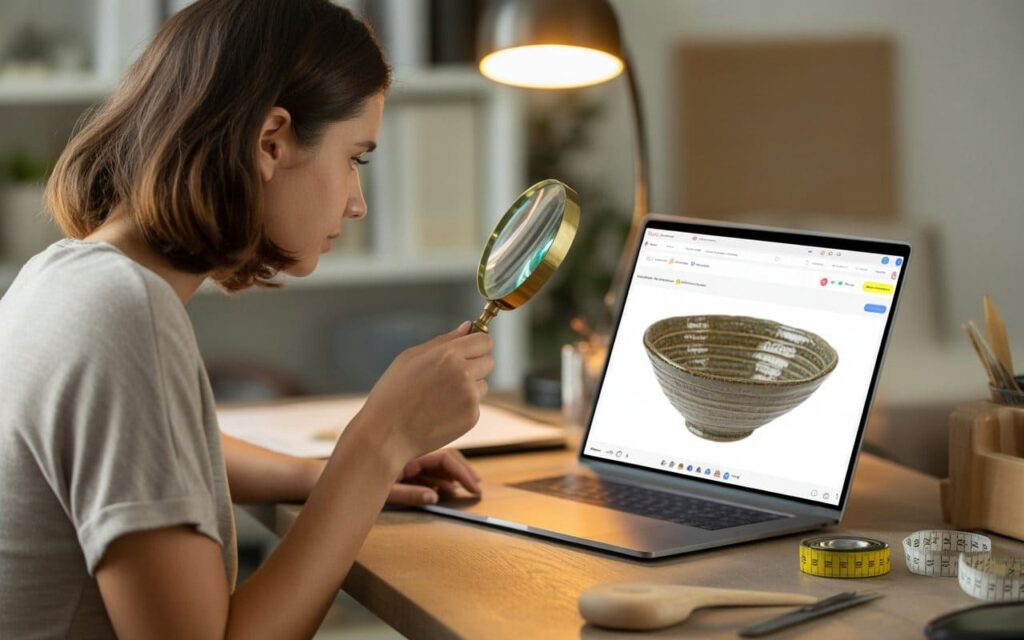
If you receive such a message from a buyer, focus and carefully examine the photo. It’s like a game of “Find 10 Differences.”
AI often distorts characters in the text or logo, can depict unrealistic lines of cracks or chips, for example, when the fragments do not match the chips. Also, the damages themselves do not correspond to the material.
Pay attention to unrealistic shadows and lighting. Shadows may not match the main photo — these discrepancies are clearly visible in the examples.
Additionally, to check if an image was created by artificial intelligence, you can use methods other than visual inspection:
- Firstly, there are online detectors that analyze the photo and show the likelihood of AI generation.
- Secondly, you can check the metadata. Metadata in generated images will either be absent or suspiciously clean.
But, of course, none of these methods provide a 100% guarantee.
How to recognize AI generation in a product photo
| Sign | What to pay attention to |
|---|---|
| Texts and logos | AI often distorts letters, makes inscriptions unreadable or “floating”. |
| Damage geometry | Cracks or chips do not correspond to the physics of the material (e.g., plastic chip on wood). |
| Lighting and shadows | Shadows from “cracks” may not match the main light direction in the photo. |
| Metadata | Absence of camera/phone information or suspiciously “clean” file data. |
What should a seller do if you suspect fraud?
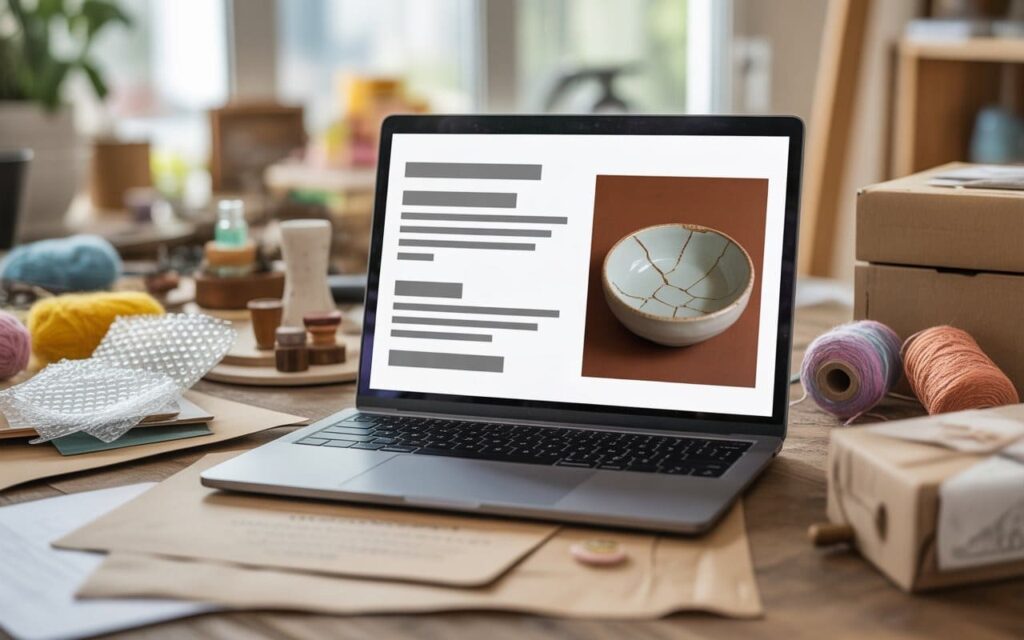
The most important thing — do not immediately issue a refund without returning the item. Always ask for the return of the item. If it is indeed broken, the buyer will have no problem sending it back. You can even offer to pay for the return shipping.
For Western Bid clients, by the way, returns can be made to our warehouse in Miami, if, for example, the order was from the USA — shipping will be inexpensive within the states and very fast.
If the buyer disappears or refuses — most likely, it was a scam.
Of course, the buyer can leave a negative review, and we are not immune to this. It is truly an unpleasant fact that can be challenged.
If it doesn’t work out, you can leave a public reply under this negative review, for example: “We offered a full refund after the return of the item, but the buyer refused.”
Of course, we write this for other buyers who will be interested in this item and come across this negative review. A reasonable buyer will read your response and draw the right conclusions.
Seller's procedure when suspecting fraud
| Step | Recommended Action |
|---|---|
| 1. Photo analysis | Carefully check the image for signs of AI manipulation and through online detectors. |
| 2. Refund requirement | Inform that you will only provide a full refund after receiving the item back. |
| 3. Logistics | Offer a return to Western Bid warehouse in Miami for US buyers. |
| 4. Handling feedback | If a negative review appears — leave a public response about the customer’s refusal to return the product. |

Conclusion
So, friends, the main idea of today’s material is this: we, sellers, must be as attentive and prepared for any scenarios as possible.
- Why do people often add items to their favorites on Etsy but not purchase?
Many sellers notice the same situation: products are actively added to ‘favorites’, compliments are left or likes are given, but there are hardly any actual orders. Most often, this means that the buyer likes the item visually but does not feel the need to buy it right now. Other factors may also come into play — high price, uncertainty about quality, unclear listing, or simply that the item is seen by the wrong audience. Therefore, it’s important not only to attract attention but also to show the buyer why this item is truly worth buying. - How to understand if a photo of a damaged item on Etsy might be fake?
If a buyer sends a photo of supposedly damaged goods, it is worth not rushing to conclusions and carefully examining the image. Sometimes artificial intelligence leaves small inaccuracies: strange lines of cracks, chips that do not match the material of the product, or distorted details — for example, text or logo. Shadows or lighting that look unnatural may also be a clue. In such cases, you can check the photo’s metadata or use services that show the likelihood of AI-generation. - What is the best course of action for an Etsy seller if a buyer requests a refund due to alleged damaged product??
The most sensible strategy is not to rush to issue a refund. It’s better to suggest that the buyer send the item back. If the damage is real, the customer usually agrees to return it. If the person starts avoiding responses or refuses to send the item back, it could be an indication that the situation isn’t entirely honest. Even if a negative review appears, the seller can always leave a public response explaining that they offered a full refund after receiving the product back.
