Why old SEO no longer saves — and what has replaced it. What an entrepreneur from Ukraine can oppose to big brands. The economy of mentions. A multi-level search architecture container, AI SEO, and manual AI Radar practically without investments. All of this is in O. Radich’s research article.
Introduction
You invested thousands of dollars in SEO. You waited for months. And then you saw your rankings slowly slipping down — under the pressure of yet another Google algorithm update, which (how unpleasant) no one warned you about.
While businesses chase after yesterday’s promotion methods, the rules of the game have already been rewritten — without announcements and without the right to appeal. Artificial intelligence is no longer a search tool. It has become a judge: it decides whether your brand even exists in the consumer’s mind.
In this detailed article, we will explore why strategies that worked in the 2010s are now gradually turning into wastefulness by 2026. You will learn how to make your website a ‘manual for AI’ — a source trusted and quoted by the algorithm. And you will become familiar with the concept of Mentions Economy: a new reality where the consistent presence of a small entrepreneur in the information space is more valuable than multi-million media budgets of corporations.
This is not just another marketing guide with tips about keywords, but a survival roadmap — for Ukrainian brands on Etsy, Shopify, and Amazon — in a world where 60% of search queries end without a single click, and your visibility is determined by an algorithm that does not forgive emptiness.
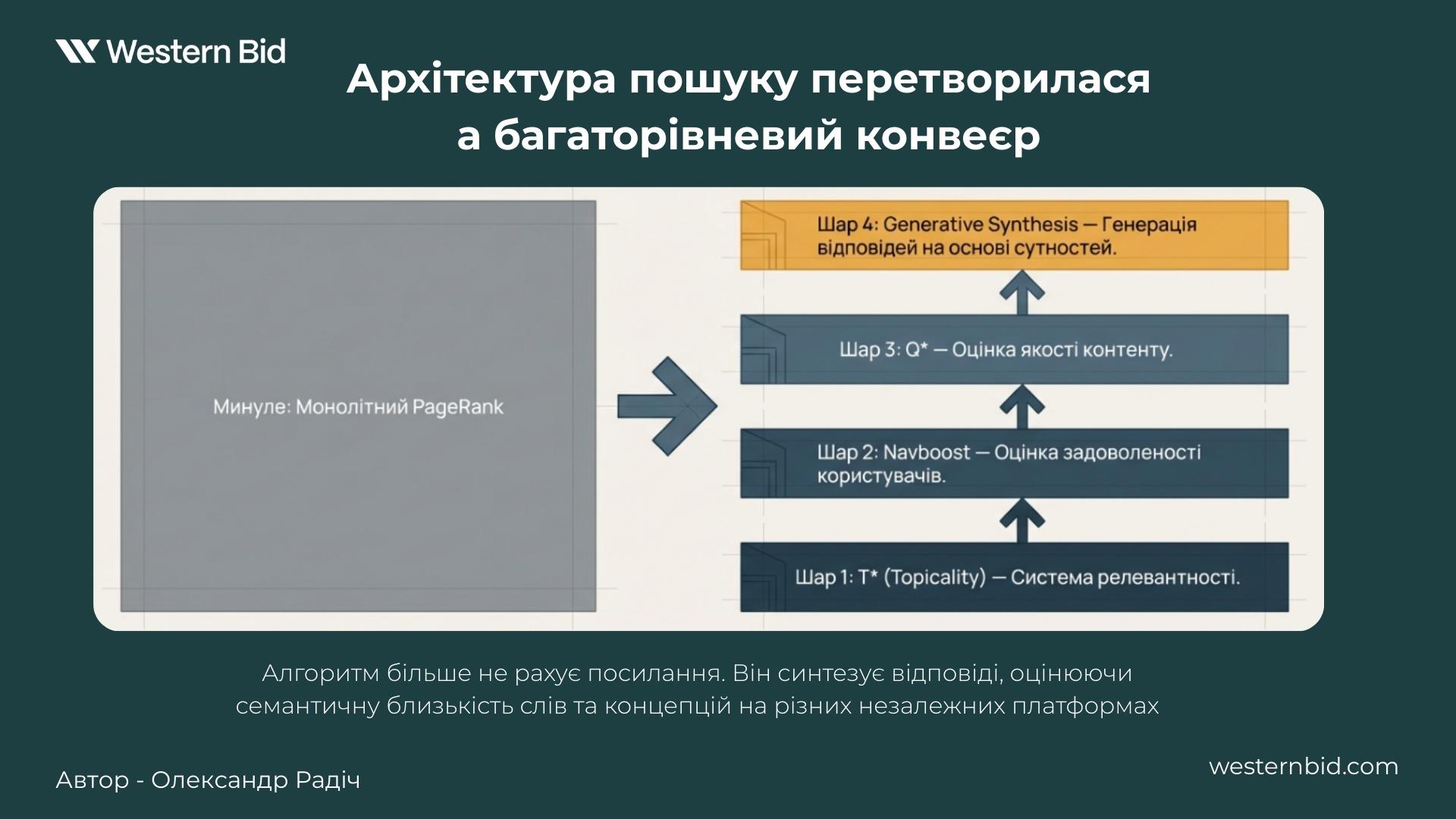
We invite you to the revolutionary era of AiSEO — where you either become a “digital gardener,” or your business is overgrown by the weeds of others’ hallucinations. The choice is yours, but with this article, we will help you decide. And with specific steps and timing.
Since 2015, we, as the Western Bid Sales Academy, have been working with Ukrainian brands entering the international market through Etsy and Shopify. And every time — the same question. From sellers with twenty thousand sales and from sellers with a hundred.
“How can we optimize the website so that it starts selling right now? I want to invest a hundred dollars today and get two hundred in a week. Who handles your advertising?”
People are ready to invest hundreds, sometimes thousands of dollars in beautiful sliders, videos, regular Instagram activities, and link building. More advanced ones hire SEO specialists for one or two thousand dollars a month and spend about the same on external links. And this still works. Usually after 6, 12, or even 20 months.
But with the advent of artificial intelligence, this scenario encounters a failure — if you ignore another golden rule. A rule that has long been effective in the market, but few noticed it in time.
In 2016–2017, I entered Amazon with my product. The team handling promotion was manipulating reviews — and we received them. Many, more than a hundred. And then, in one day, we lost everything. Including those earned honestly.
Purges on marketplaces began earlier than in search engines. Back then, algorithms learned to distinguish reality from falsehood: verified reviews from real buyers — from purchased and “motivated” ones, where the seller offers a discount in exchange for stars. Asking for an honest review is your full right. But any “motivation” instantly shifts it into the suspicious category.
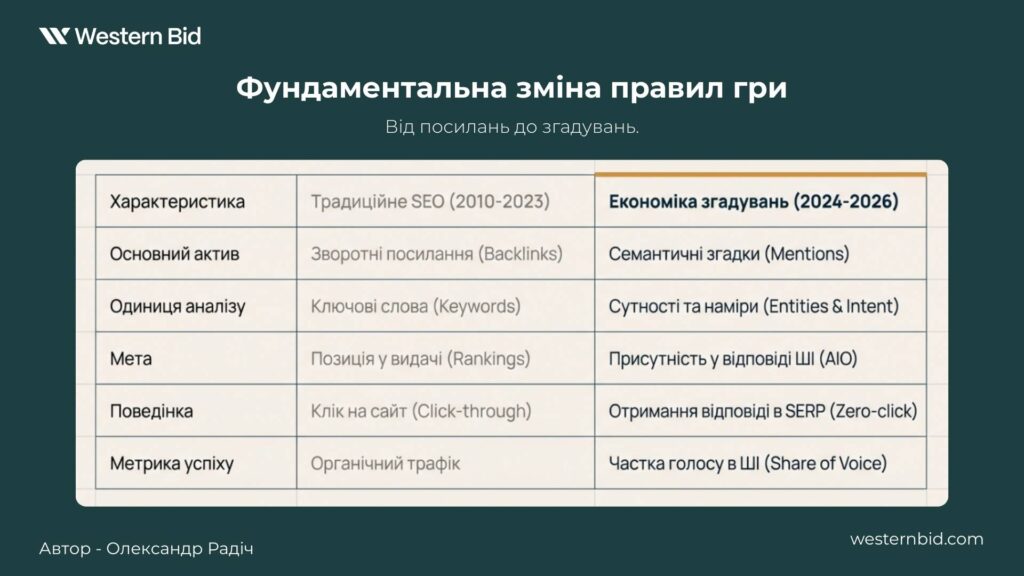
Now the same principle has come to search. And everything points to bought links — the traditional “fuel” of Google rankings — playing an increasingly smaller role. Instead, verified reviews and genuine mentions of your brand are becoming the new currency of trust.
So, what should you do?
Step one — Manual AI-Radar
Sean Anderson, who inspired me to write this article, compares a business owner to a gardener: cultivate what is useful, weed out the weeds. He references the classic book by James Allen “As a Man Thinketh” (published in 1903) — and the metaphor still works today. If you consciously do not sow facts into your information space, it will grow over itself. With other narratives, outdated data, hallucinations of algorithms.
Your reputation is everything in the economy of mentions. And you don’t even need to understand attributes like nofollow or advertising markup. You need something else: regularly gather feedback and be “alive”, present online — on your own website and on external platforms. Reddit, Quora, industry forums — it’s there that AI searches for confirmation of whether you even exist.
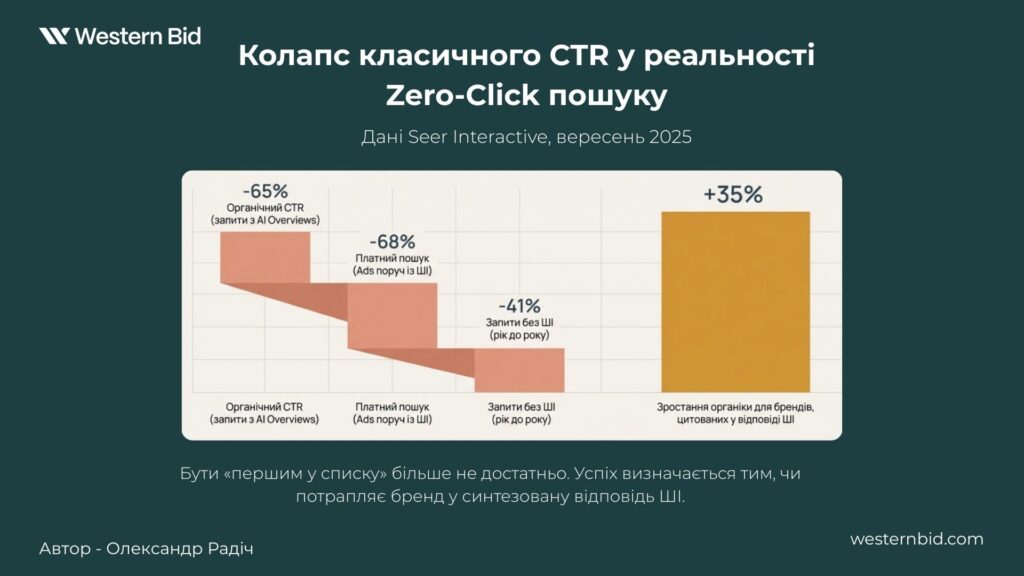
In 2024, most Google searches (about 59%) end without a click on any result: people either get the answer directly in the search or enter a new query. Almost 30% of clicks go to Google services (YouTube, Maps, Images), and about 36% — to the open web (around 360–374 clicks per 1000 searches in the US and EU).
Zero-click search is a Google search that ends without clicking on any result, including sites, Google services, and ads.
The answer is given by the search engine itself — or AI. So the question is no longer “how to attract traffic,” but “what exactly will AI say about you when asked”.
We break this down into four steps — for a conscious seller and brand owner who wants to grow. Not for corporations with budgets of tens of thousands a month. For you.
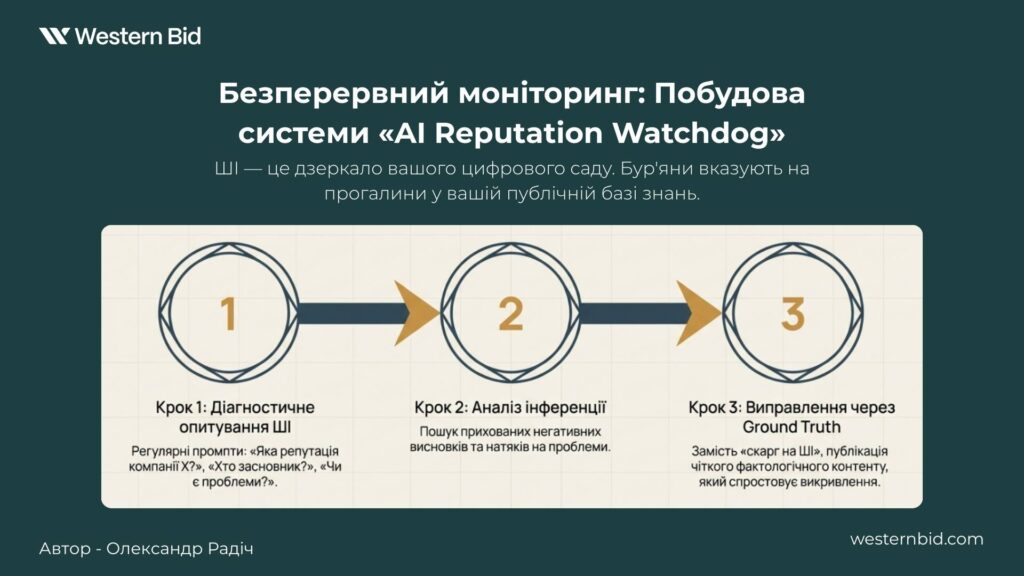
Step one: check what artificial intelligence is saying about you.
This is “Brand Radar” or “AI Audit” for small budgets. Modern professional SEO platforms charge for this (Brand AI audit or GEO monitoring) from $29 to $999 per month depending on the plan and platform. Basic plans for SMB (Small and Medium Business), such as Otterly.AI or BrandRadar Signal, start at $29–$399/month with basic mention tracking in AI (Google AI Overviews, ChatGPT, etc.). Premium options from Semrush or Ahrefs — $139–$699/month with full competitor analysis, optimization, and reports.
Useful link:
https://searchengineland.com/google-search-zero-click-study-2024-443869
Prices of key services
| Service | Basic Plan | Premium Plan | Features |
|---|---|---|---|
| BrandRadar | $399/month | $999/month | AI Tracking + SEO, Content Optimization |
| Otterly.AI | $29/month | $989/month | Budget Monitoring 6 AI |
| SE Ranking | $69/month | $149+/month | AI Search Visibility |
| Semrush AI | $139/month | Custom | Visibility Toolkit |
| Ahrefs Brand Radar | $129/month | $699/month | 250M+ Prompts, Multi-platform |
In Ukraine, local audits start from $100, but for AI functions, global tools are recommended.
But you can start from scratch — just open ChatGPT, Gemini, or Perplexity and ask: when your store opened, where it is located, what it sells, what its history is. Request a description of your collections and services.
The results often surprise. In March 2026, I provided Gemini with my name, and instead of the usual responses regarding expertise in Shopify stores and Western Bid representation, it unexpectedly registered me as a founder of a Ukrainian brand I work with on a contractual basis. This answer surprised me and the actual founder, who was present at the demonstration.
Where AI makes mistakes — it either “guesses” from fragments or openly recommends a competitor. Where there are gaps — it’s simply because you haven’t provided it with enough structured information in the format it prefers.
This is the “Eyes and Ears” stage — an audit of your city. You check where the mess is, what digital footprint has been left. And only after that — you grab your shovel.
Step two: cultivate the beds
Now — emergency aid. Give AI a fundamental, canonical truth about your business. And the main bastion, beacon, and source of this truth is your website. It is from here that algorithms primarily gather information about you.
Here are four pages you should pay attention to today.
Home Page
It should align with the brand values and immediately show: how the customer’s life will improve thanks to your product. There is one trap here that most fall into. The hero of the story tries to become the seller — not the customer. But a person visiting the site is looking for themselves, not you. They should recognize their problem, their context — and understand that you are the one who solves it. Describe who your customer is and what keeps them awake at night. The rest are details.
About Us
Let’s be honest: most sellers here are hopelessly mistaken. Some feed neural networks dry lists of products, only to receive emotionless corporate surrogate content in return, which even the most loyal customer will close in seconds. Others indulge in high poetry about their uniqueness: sang of “stellar service,” “dream team,” and sleepless nights spent working. This pretentious self-deception, unfortunately, remains a disease not only for beginners but also for experienced market players.
Google and AI value something else. Authenticity, original storytelling, and proofs that can be ‘stitched into the matter’. Live stories with details, numbers, references — even with elements of humor and self-criticism. If such stories are absent, the chances of receiving a bonus from the algorithms drop significantly.
What we do with our clients: We conduct a separate 30-minute interview, during which we extract all details about how the business developed and operates, from the first person, then turn it into interesting and authentic content. Work on some “About Us” pages takes 1-2 weeks. This is not a game.
Product and Collection Pages
Be honest: what kind of product it is, how to use it, how to care for it, specifications, and features. Processing time, delivery date, who will deliver it and for how much. And — most importantly — what to do if something goes wrong: returns, refunds, other mishaps. Yes, there are separate pages with policies for these. But key information should be where the person looks towards their wallet — directly on the product page.
Contacts
The most insidious trait of the internet — its impersonality. Address, phone, social networks, various communication channels — all these signals good reputation. For a living person and for AI equally. The buyer should understand that behind the brand stands a real person responsible for their honest name.
| Page | What to do |
|---|---|
| Home | Customer — the hero (not you personally and not your brand or your product, you are just a guide and helper). Describe their problem and show the solution. |
| About us | A live story with details, numbers, real moments. |
| Products | Specifications + delivery conditions + return policy — all on one page. |
| Contacts | Address, phone, social networks, maximum channels of communication. |
Stage Three — Adding Facts: Creating the Canonical Source of Truth
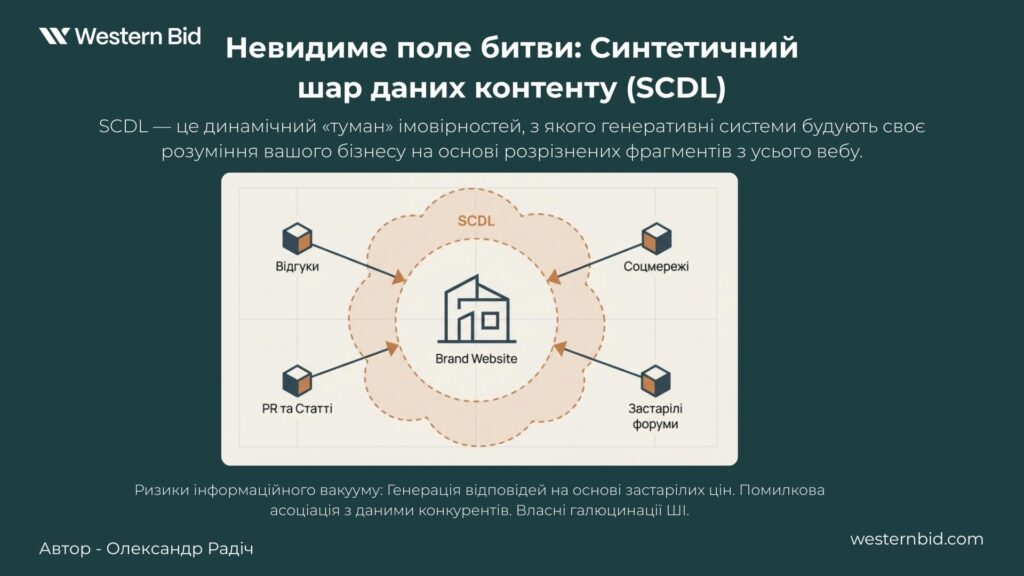
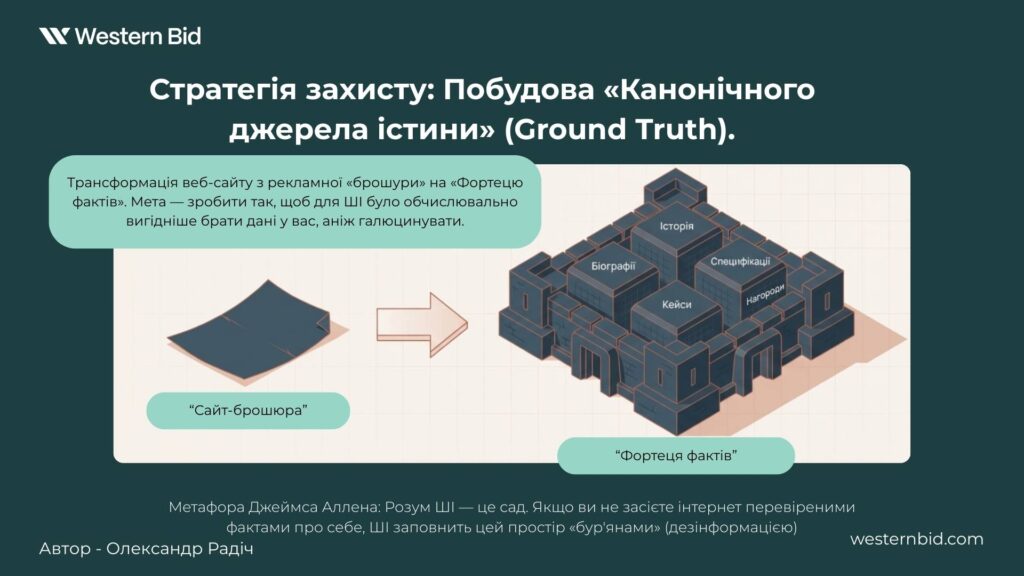
The third stage is the transition from simple online presence to creating the “Canonical Source of Ground Truth”. In the world of modern AI, your business is not what you think it is, but what algorithms (like Google AI Overviews or ChatGPT) can infer about it from fragmented data on the internet. This space of assumptions and fragments is called the “Synthetic Content Data Layer” (SCDL) by Shawn. If you leave this layer empty, AI will fill it itself — often with errors, hallucinations, or data from competitors.
SCDL (Synthetic Content Data Layer) — is an invisible digital space where AI models (such as Google Gemini, ChatGPT, or Google AI Overviews) gather pieces of information from across the internet to generate a response about your company. If this layer lacks clear data, AI begins to guess, make false inferences, or even “hallucinate”.
Benjamin Franklin understood this back in the 18th century. His fight against the “slander” of a competitor-merchant was the first-ever battle for reputation management. Today, your “merchant” is an inaccurate algorithm. To avoid falling victim to the “Third Point Emergence Failure” — when AI takes two true facts and makes a false third conclusion — you must act proactively.
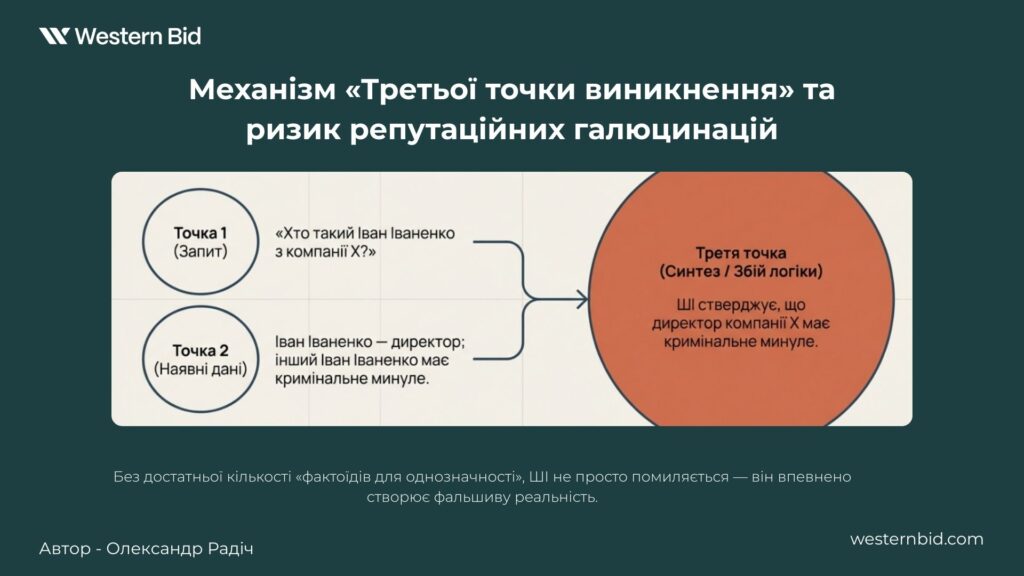
Your task at this stage is to sow the seeds of useful facts in your “digital garden” to displace the “weeds” of disinformation. This means publishing a comprehensive array of verified data on your website: from detailed brand history and team qualifications to product technical specifications.
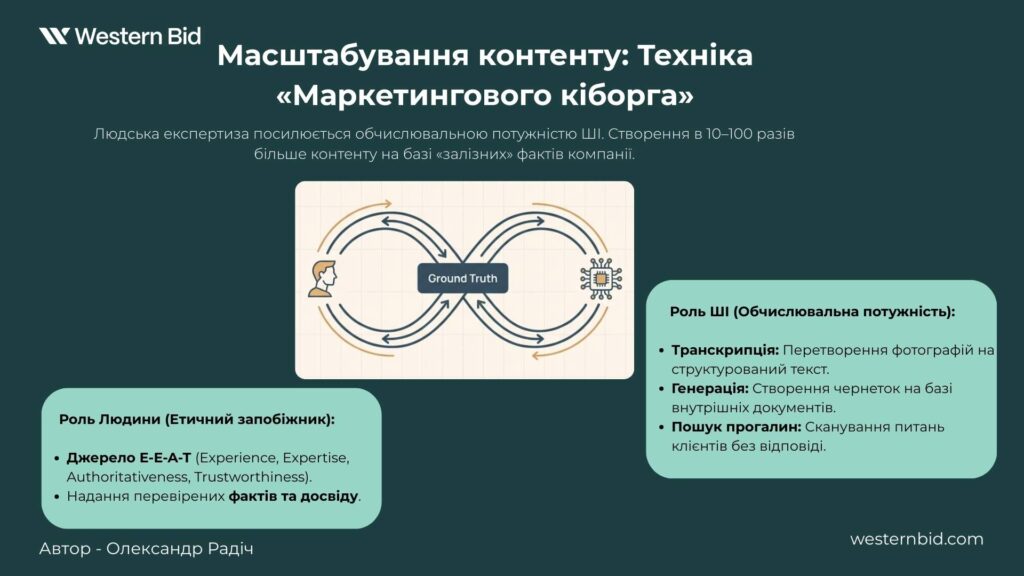
Use AI as a “super-fast ghostwriter” to create drafts, but each fact must be verified by an expert. Only then do you create true E-E-A-T (Experience, Expertise, Authority, Trust). When you saturate SCDL with truth, you reach the “Saturation Point of Conclusions”. Now AI doesn’t need to guess — it takes your canonical facts and generates accurate responses for clients based on them. Your goal is to make your website so authoritative that algorithms perceive it as a “manual” in your niche.
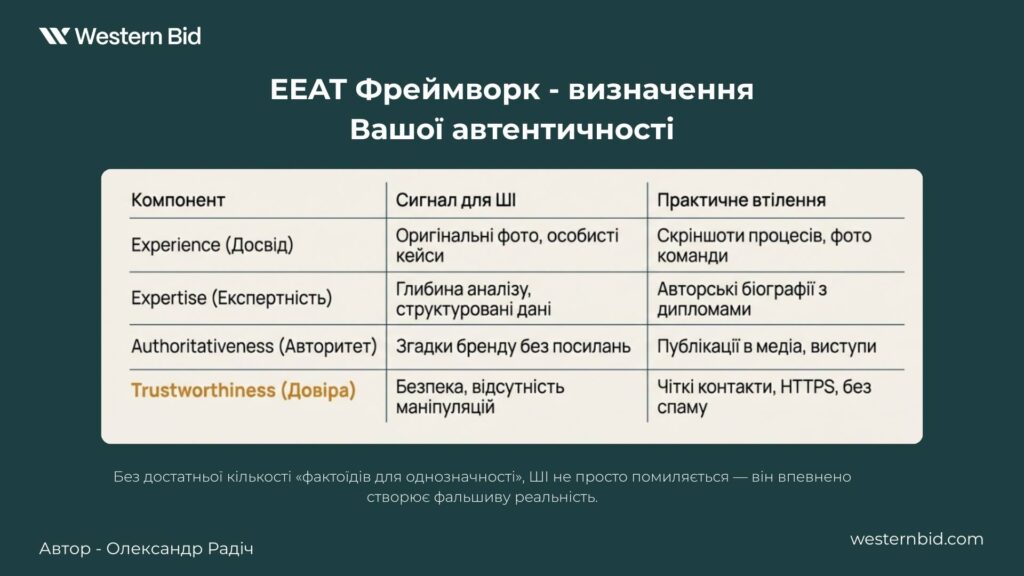
Step four: become the watchdog of your reputation
Sean Anderson offers a simple routine—without big budgets and complex tools. Just 30 minutes a week and one clear habit.
Monday, 15 minutes. Open ChatGPT, Gemini, Perplexity, or Claude—any of your choice—and ask about your brand. Change angles: ask as a customer, as a journalist, as a skeptic. Note what you see.
Wednesday, 15 minutes.Post something live on social media. A behind-the-scenes shot, an announcement of a new product, a link to a blog post. A small detail—but it signals to algorithms: the brand is active, authentic, and exists. This adds weight to your trust layer better than any purchased link.
Once every week or two— browse your website and make small updates. A new reward, fresh feedback from a customer, adjusted brand information. Sean recommends once a month—but in my opinion, that’s not enough.
And finally—about the main advantage that is rarely spoken openly about.
What is Mention Economy?
In the economy of mentions, small businesses have an edge over corporations. While large brands carefully coordinate each news release and pay thousands for one article — you can act today. Forums, communities, social networks, comments, live discussions — these are territories where active engagement wins over wealth. PR in the modern mentions economy can be entirely free. And highly effective.
The concept of the «Mentions Economy» is replacing the traditional era of backlinks. In a world dominated by AI responses (such as Google AI Overviews), brand mentions become a new currency and an «economy of consensus».
Previously, the main signal of authority was backlinks. However, AI algorithms now focus on brand mentions in authoritative contexts, even if they don’t contain active links. When AI (for example, Gemini) formulates a response, it searches for an «independent consensus» across the web. If your company’s name is frequently mentioned alongside a particular topic on various reputable sources, AI perceives this as a trust signal and includes you in its summaries.
What should a small business owner do?
For small businesses, this even creates a certain advantage, as it allows competing with giants not with advertising budgets, but with a clear identity. Here is a step-by-step plan:
- Become a “Digital Gardener”: View your online presence as a garden. If you do not sow “useful seeds” (facts about yourself), “weeds” (AI errors or competitor data) will grow there.
- Create a Canonical Source of Truth: Your website should be the main place where all indisputable facts about your business are collected: history, team qualifications, detailed service specifications. This is what AI will use as a “manual”.
- Implement SCDL Tactics: Use AI to find “gaps” (Opportunity Gaps) in what it knows about you, and fill them with comprehensive content on your website.
- Use Disambiguation Factoids: If AI confuses you with someone else, publish clear, simple statements to differentiate (for example: “We are a bakery in Hranok, founded in 2015, and have no connection to the same-named store in Glasgow”).
- Work on Recognition (Branded Search): Encourage clients to search for you on Google by your brand name, not just by general queries. Branded search is the strongest indicator of site quality.
The main rule is — Human-in-the-Loop: AI can help generate ten times more text, but every word must be checked by an expert person for accuracy (E-E-A-T).
What to take away from this article right now
In 2026, the winner is not the entrepreneur who simply buys links (but I admit – this should be, it can also be a free PR strategy), but the one who manages their own facts. Old SEO gives way to Reputation Economy, where artificial intelligence shapes your brand’s reputation based on “digital consensus.”
Your website should become the Canonical Source of Truth, enriching the synthetic data layer (SCDL) with verified information. Don’t let algorithms hallucinate — be a “digital gardener”: eradicate weeds of misinformation and sow the network with genuine reviews and facts. Small businesses have a unique advantage: sincerity and speed of action matter more than corporate budgets. The future belongs to authentic brands that write their own manual for AI.
Is it true that traditional SEO with link building no longer works?
It still provides an inertial effect, but it becomes a “furnace” that burns the budget. By 2026, Google and AI algorithms are looking not at the number of links, but at The Economy of Mentions. If people are not talking about you in forums or social networks, links from SEO specialists appear to AI as artificial noise that it simply ignores.
What is "Zero-click search" and why is it a disaster for regular websites?
This is a situation where the user receives a response directly on the search page (from the AI widget), without visiting any website. It is a disaster for those who are simply chasing traffic. Now your goal is not just a “click,” but for the AI in its response to mention your brand as the most reliable solution.
How can AI "hallucinate" about my business and how to prevent this?
If there are few facts about you on the internet, AI fills in the gaps with assumptions — it might attribute other people’s products to you or even close your store in its responses. This can be prevented by creating a Canonical Source of Truth on your website: pages where every fact about the brand is described as clearly as possible.
What is SCDL (Synthetic Content Data Layer) in simple terms?
This is a “digital cloud” of knowledge that AI creates around your brand. Imagine AI as a student preparing for an exam about your company. SCDL is all the notes he has found. If there are no notes or they are inaccurate, he will “fail” the exam in front of the customer.
Why does the author compare a business owner to a "digital gardener"?
Because reputation in the age of AI is not built once. It is a living process. You must constantly “weed” (disinformation) and “plant new seeds” (fresh facts, reviews, news). If you leave your garden unattended, it will instantly be overgrown with misinformation.
What is the main mistake made by sellers on the "About Us" page?
They write either dry corporate texts or exaggerated praise of themselves. AI and modern buyers are looking for authenticity. A real story with figures, fails, real photos, and proof that behind the brand are people, not a text generator.
How can the "Third Point Error" ruin your reputation?
This is a logical AI mistake. For example: 1. You sell furniture. 2. A furniture factory in your city has closed down. 3. The AI concludes: “You closed.” To prevent this, you need to publish Disambiguation Factoids — short, direct facts that disprove possible incorrect associations.
Can a small entrepreneur without a budget beat a corporation in 2026?
Yes, and this is the main insight. Corporations are sluggish, their communications are sterile. A small entrepreneur can be everywhere: on Reddit, in comments, on forums. AI perceives this “living presence” as a signal of higher trust than a paid article in major media.
What is "Brand Radar on Minimal"?
This is your weekly routine. Instead of expensive services for $500, you go yourself to ChatGPT or Gemini and ask: “Who is the founder of (COMPANY NAME)?”. If AI gives nonsense — it’s a signal that your website urgently needs factual updates.
Why has the contact page become critically important for SEO?
Impersonalism is the enemy of trust. For AI, having a real address, phone number, and links to live social networks is a marker that you are not a “one-day site” created by bots, but a real business with E-E-A-T (Experience and Authority).
How have reviews become "the new currency" if they cannot be bought?
AI has learned to recognize “motivated” reviews. True currency is unfiltered consensus. It can only be obtained through quality service and requests for honest feedback. One genuine review on Reddit weighs more than 100 bought “stars” on a website.
What is the main advice for those entering international markets (Etsy/Shopify)?
Stop asking “where to invest $100 to get $200 tomorrow”. In 2026, the winner will be the one who makes their brand “visible and understandable to AI”. Start managing your facts today before algorithms or competitors do it for you.
