A large number of likes without sales on Etsy indicates a gap between liking the product and the actual need to purchase. The main reasons for low conversion: mismatch with the target audience, fear of online purchases of expensive items (over $300), and misunderstanding of the product’s usage scenarios. To turn “favorites” into orders, it is necessary to clearly target a paying customer, use visualization in interior design, and increase trust through reviews and social proof.
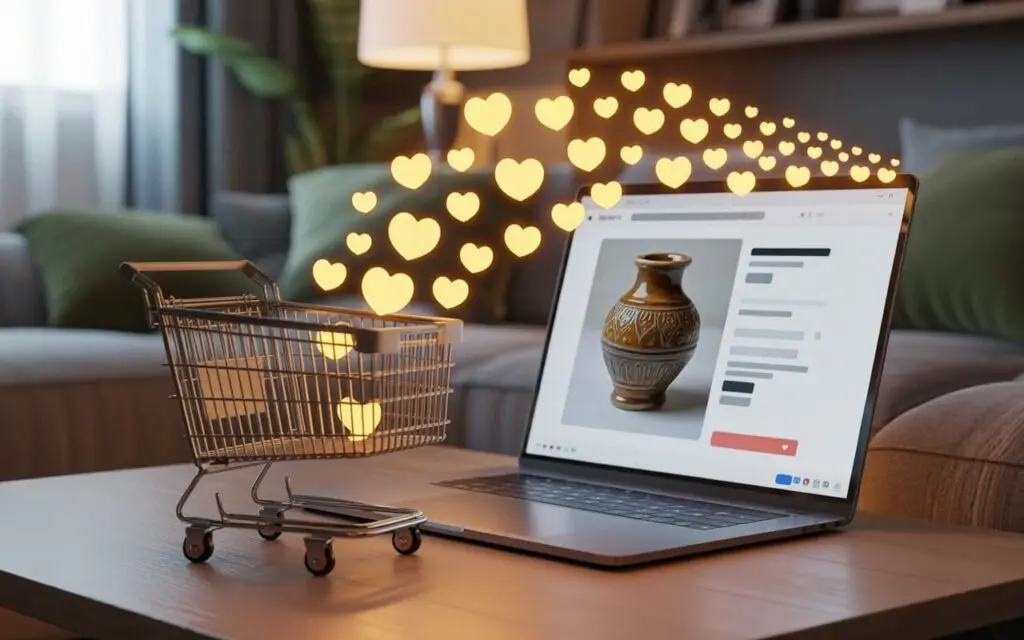
5 reasons why they like but don't buy
Reason #1: The product is not needed
For these specific people you are showing your products to, your products are not needed. You’ve probably experienced this very often too: you like something, you look at it, but it doesn’t necessarily mean that in your mind you are thinking that I need to buy this thing right now.
Reason #2: Too expensive
This costs too much.
Reason #3: Fear of purchase
People are afraid to buy. This, by the way, is very often related to high prices and lack of trust.
Reason #4: Something unclear
A person finds something unclear — meaning something specific in your listing causes concern.
Reason #5: Not your target audience
And lastly, the most important — I believe that a large part of the problems can be solved simply by understanding and fixing this last reason: you are offering and showcasing your product not to your target audience.
Explanation of reasons
The first example that immediately comes to mind is a woman who created stunning, completely unique historical costumes, made correctly, after conducting thorough research. Can you imagine how much effort, love, and expensive materials go into producing such costumes?
Of course, her costumes were sold for between $500 and $2000 each. She posted these costumes on Facebook and Instagram and received a huge number of likes. People simply admired her work, but no one actually bought these costumes.
Why do people buy costumes? They buy them for Halloween or some carnival. The usual cost of a costume for a carnival or Halloween is approximately $30 to $50. Anything $50 and above is considered an expensive costume. The target audience immediately becomes very narrow.
As for such well-made costumes based on historical facts and eras — costumes are needed in Hollywood when they film movies, or in theaters. There are even specialized shops, costume departments, where small theaters come and rent these historical costumes.
There is a target audience, but it’s not located there, not in this space of Instagram, Facebook, among ordinary people buying $30-50 costumes.
So, we’ve covered these five reasons: I don’t need it, I’m afraid, I don’t understand something, it’s too expensive, or it’s just not for me — I am not the target audience. These are the reasons why a person might like, write a wonderful comment, and not make a purchase.
Why is the product added to favorites but not purchased?
Reason | Nature of the Problem |
|---|---|
Wrong audience | Products are seen by casual visitors or competitors, not actual buyers. |
Purchase anxiety | Lack of trust in quality or security of the deal (especially for goods over $300). |
Price barrier | The cost exceeds expectations or the budget of the target market segment. |
Lack of information | Uncertainty about sizes, options, or high shipping costs in the cart. |
5 steps from likes to sales
Step #1: Find your target audience
Let’s start our five steps right now, beginning with the most important — your target audience. How to make sure the right people find you?
We have viewers, followers, friends, relatives, competitors, other artists who also subscribe to our channels. But if another artist sees your painting and envies it, or on the contrary, is happy for you and writes “wow, cool, what a wonderful painting, wow” — that is not a buyer. And, of course, there are buyers, but they are not your buyers, as we discussed about costumes. The more you narrow your target audience and understand it, the easier it will generally be for you to find, target, and comment on your listings.
Let’s give an example. Let’s take handbags. I know there are people who are true masters, who make stunning bags from high-quality Italian leather. They have great designs, very unique. And such bags can cost $300, $500, $2000. That’s a normal price.
And imagine, you post such a bag on Facebook, Instagram, and you receive a request: “Wow, what a cool bag, I want to gift such a bag to my wife for her birthday, but my budget is no more than $150.” This is, in principle, a normal budget for everyday items, for China, for a medium-quality brand in a regular store. You can easily buy even for $20 or $30.
And you want — the person liked my bag, he wants to buy it, and although the price is not low, you simply cannot sell these products at this price of $150 based on your cost price, material costs, and labor costs.
Do you understand? If you clearly know where your target audience is, you will simply confidently tell this person that I have such a competitor, I know him, he makes cheaper bags. And what is this person looking for? Is he looking for a very expensive, high-quality, cool bag? Of course not. He is looking for some fun, interesting, modern designer bag with personalization as a gift for his wife’s birthday.
And, you see, the person offering such personalized bags — let’s say he imports them wholesale via AliExpress, brings them to himself, and then adds personalization or some accessories — he also has his own business, and it’s also handmade. This can also be sold on Etsy, but it’s completely a different business model, and to some extent, it doesn’t compete with you at all if you produce such a designer, very expensive, high-quality bag.
How to target the target audience?
Therefore, when you create listings or develop products, make sure that only the people you want to see them actually see them. That is, your target audience.
First of all, it is essential to ensure that your business page on Facebook and Instagram does not match your personal page. I’ve already mentioned this because our friends and relatives often praise us, creating an illusion — an illusion that our business is already doing well, and that I am talented, and I’m being praised.
On the other hand, in the listing title, in your models, in your mockups — everything you do should specifically target this target audience. If it’s a high-quality, expensive brand, like leather, when you create your ads on Facebook or Apple, you should definitely indicate a certain income level when targeting your audience. In other words, it won’t be people looking for $50 or $30 gifts.
Your headlines, your branding, and all your marketing packaging should be focused specifically on your target customer.
Step #2: Conduct research
The second reason is insufficient research. You need to understand what people like about your products. And what do they like? The mood, the color, the emotions it evokes. When talking about this research, you need to understand: is everything clear in your listing for the buyer? The simplest examples: very often our options that we offer on the side do not match the photos. They are either completely wrong — for example, a person sells the wrong size tablecloth or curtain that does not fit their standard options, a tablecloth that fits their standard table.
In other words, somehow you confused a person with your listing: they liked it, they liked it and added it to favorites, but didn’t proceed to the cart. The same can happen: a person might have reached the cart, but then saw that the shipping is very, very expensive.
Conduct research, look deeply into your listing, and find out what specifically people like and what they praise you for. Maybe there are some things they don’t like and leave as is. You can talk to these buyers, ask them to comment more. Maybe something is missing in my listing, maybe you don’t like something, you liked something, or maybe something is missing.
Step №3: Show why your product is needed
We always, most often, expect that a person will figure out for themselves what they need this item for. That is, for some reason, we believe that if a person liked or liked the post, it must mean they need this item. No. A person might not even think about it. They like the painting, but where is it even? Why do they need this? Why should I buy it right now?
The right marketing packaging answers all these questions: why now? Where to hang it?
Let’s take the example of a currently very popular painting of bread, called sourdough — natural bread made with a starter. It is currently the most popular thing. And people started painting such bread. Bread with butter. Oh, how appetizing it looks, with a crispy crust. Just wonderful. I will, of course, like such a painting, but it doesn’t necessarily mean I will be thinking about this: oh, maybe it’s a gift for my daughter, maybe she will hang such a picture in her room, she loves baking so much.
If I see how this girl excitedly opens such a painting, hangs it in her room which matches her atmosphere — my daughter might like something like this. Or how it looks in a kitchen, where I cook, maybe I make the same bread or some pastry. And this appetizing picture, or one that hangs right above the dining table. This evokes not just a desire to like, but I start to imagine how it would look in my home.
Which interior does your painting suit? Be sure to take photos, make pictures in life-size. Think about this, consider such questions. And try to ensure that the answers to these questions are already in your photos and videos.
Step №4: Overcome fears and insecurities
Someone liked something, but they are not sure if it’s right that they liked it. You might not even think about such a turn of events where a person thinks: maybe I like it, or maybe it’s actually ugly. Or, perhaps I will buy something, and tomorrow I will see something similar, and it will be three or four times cheaper. Or, the item might be expensive, I don’t know, maybe it’s of poor quality, or maybe it’s just some kind of scam.
This mostly concerns expensive works. When I say that some painting or some item, in general, costs more than 300 dollars — that’s a very expensive item, I mean exclusively online sales.
A person, entering a regular physical store, touching the item, seeing it, recognizing the brand, and looking at the actual store, can often spend a thousand, two thousand, or five thousand dollars. I know artists who take commissioned paintings for five, ten, or twenty thousand dollars.
But on marketplaces like eBay or Etsy, 300 dollars is quite an expensive price. Physical stores and boutiques, as well as online sales — these are two completely different worlds.
How to reduce insecurity?
You should do everything possible in your listings to reduce this uncertainty. What helps us eliminate uncertainty? It’s reviews, it’s likes, it’s stars, it’s the possibility to make returns, and quality guarantees. It’s when articles about you are published in magazines. It’s when you, as an artist, can show that you participate in exhibitions, when there are reviews of your paintings by art critics, when people see critique, when people understand: oh, this is not only liked by me, it’s objectively beautiful.
Step #5: Don't sell everything at once
And the last, fifth step — especially when it comes to expensive items: very often, a person wants to sell everything at once.
If you don’t want to cater to someone else’s taste and do your own thing, create, be genuine, and be a creator, it often takes from two to five years to build that reputation, gain recognition from buyers and critics. But while you’re doing this, maybe it’s worth thinking of something smaller, less intimidating. Because your paintings are priced at five thousand dollars, maybe you can sell prints, calendars.
When you’ve already made a sale of a print or a small item once, firstly, it will be much easier for them to make a repeat purchase, and secondly, if you’ve truly impressed them with your art, then word of mouth: you can’t imagine the kind of talented artist I found, and so on.
5 Steps to Increase Conversion
Step | Seller’s action |
|---|---|
1. Targeting | Separate personal and business pages; focus marketing on paying customers. |
2. Research | Check the relevance of options to photos and analyze feedback. |
3. Visualization | Show the product in real usage scenarios (interior, gift). |
4. Social proof | Add reviews, certificates, photos from exhibitions to reduce uncertainty. |
5. Product ladder | Offer cheaper items (prints, calendars) for the “first touch”. |
Conclusion
So, I hope this material has been useful and interesting for you. I think the main thing to remember is that when this love and enthusiasm for your product meet a real need, that’s the moment when magic happens, and a sale takes place in your store.
- Why do people add items to their favorites on Etsy but don’t buy?
Most often, the reason is that sympathy has not yet equaled need. A person may genuinely like your product on Etsy, they like it or add it to favorites, but they do not feel that they need this item right now. Adding high prices, fear of online shopping, confusion in the listing, or showing the product to the wrong target audience — and you get many “favorited” items but few sales. To increase sales on Etsy, it’s important not just to gather reactions but to combine emotion with a specific buyer’s need. - How to find your target audience on Etsy and stop getting “empty” likes?
If your listings are seen by the wrong people, there will be no sales — even if the product is quality and unique. The correct target audience on Etsy is not Facebook friends or competitors praising you. It’s buyers who can and are ready to buy your product at your price. Start with clear positioning: write headlines, descriptions, tags, and visual presentation that speak directly to your buyer. If you sell expensive designer items, do not target those searching for budget gifts. The better you understand your client, the fewer “curious” likes you’ll get and the more genuine orders. - How to turn likes into sales in your Etsy shop?
To convert likes into sales, you need to follow several key steps. First, conduct research: what exactly do people like about your product, and what might prevent them from buying? Second, show why your product is needed — not just a beautiful photo, but a real usage scenario in the buyer’s interior or life. And most importantly — dispel fears. Reviews, guarantees, return options, social proof, publications, participation in exhibitions — all of these increase trust in your Etsy shop. When love for the product meets trust and a real need, that’s the moment when a like turns into a sale.
I wish you more sales in your shop, and that you find immense satisfaction not only from sales but also from comments, recognition, and admiration for your work. And I wish your business to thrive and your creativity to flourish!
