Good day, hello everyone! This is Masha Kaganovich with you, a marketer at Western Bid. Today’s article is dedicated to trends in digital products. But don’t rush to confuse: we’re not talking about which niches of digital products are popular now, but specifically about style trends.
Why digital goods have become more relevant
The thing is, digital products have now naturally become much more popular — primarily due to recent changes in tariffs and frequent customs delays. That’s why this fall, even those sellers who previously only dealt with physical goods have started to look towards digital formats. We are talking about patterns, wall posters, invitation designs — everything related to style, aesthetics, and themes.
Of course, there are digital products that are almost independent of style — for example, resumes, tables, various spreadsheets, or templates with functional purposes. For them, the main thing is not appearance, but usefulness, the value they provide.
But today, I will talk about entirely different products — those that depend directly on design, new trends, and visual appeal. Everything now revolves around aesthetics. And that’s precisely why, in 2025, these aspects are becoming key. So next, I will share about the seven main trends in the themes and styles of digital products.
Where to look for trends
Okay. The first thing to say is that you can’t find these trends on Etsy. Etsy, as we know, and I’ve talked about this many times, always lags behind the market by 6–8 months. So, trends can be found simply by searching Google, Anthropologie, Target, Google Trends, Exploding Topics, basically in various places — Vogue, magazines that predict and forecast trends. And honestly, why do all that work when there’s a great team of marketers who do this research for us? And in stores like I already mentioned — Target, Anthropologie — all these trends are already shown, and on Etsy, they only appear 6–8 months later. So why not? Why not take advantage of this? That’s the first point.
Trends of physical goods = trends of digital goods
The second point is that people very often do not understand that trends in digital goods stem from trends in physical goods. That is, what I filmed a video about regarding styles of physical goods can often simply be applied to digital ones. Why people don’t do this — I don’t know. In this article, I will show you how trends in physical goods translate into trends in digital goods. Without further ado, let’s get straight to the content.
Trend 1: Cell (Gingham)
So, the first trend, at least for this fall and winter of 25-26, I can tell you for sure — it’s gingham. Gingham comes in different variations. It’s not just a simple checkered pattern; it’s called “gingham” in English. It’s not an ordinary checkered pattern. You know, like a chessboard, for example, a checkered pattern. No, we’re talking about a solid-colored check. It can be brighter, or more pastel-colored. Probably, pastel shades are more popular, but not necessarily. And we see them in various products — for example, a frame for a painting, a dress, earrings, or in the way the letters with a boy’s name are filled in his room, or scarves for people or dogs. Well, basically, it can be a tablecloth, anything really. The same applies to digital goods. So, whatever letter shapes you choose, you can incorporate this checkered pattern inside them, right?
Trend 2: Monochromaticity
Let’s move on to the next trend. The next trend is monochromaticism, a monochrome. What is a monochrome? It is when several colors all belong to the same spectrum. Well, we have a color wheel, and we select only a certain spectrum. So, it could be from light blue to dark blue, or from pink to red, or perhaps pink, red, and orange together. Or it could simply be black, white, and gray colors.
You see, this is very popular in fashion now, where colors have this monochromatic nature and do not have any other, say, additional patterns. In clothing — here you go, green-green, blue-blue, orange-orange, and so on.
By the way, I am currently wearing monochromatic clothing — such as light purple and pink together. All of this belongs to the same color range. Just a bit more blue is added here, and a bit more red there. But one transitions into the other, do you understand?
Nowadays, it is very common and very popular to do pink on pink, blue on blue, red on red. Once, Matisse introduced this technique in his paintings, where he painted with the same color — meaning the background and the object were approximately in the same tone. And this theme is very popular now.
Monochromaticity in digital products
But this is related to physical goods. And we see this in clothing as well. Now, let’s smoothly move on to digital products. For example, please, a monochromatic invitation — white on white. That is, the shape of the letters just stands out. And this is very popular. For statistics — 39 people purchased this invitation in the last 24 hours.
There’s also such a trick — making mockups where a product is advertised on a monochromatic, meaning pink on pink background. And this way, it allows the product to stand out more.
Sometimes, these can be, for example, invitations like these. Bright pink background with slightly darker, more red letters. Basically, just two colors.
In short, all of this relates to such… You know, there’s something calming and pleasant to the eye when we see it. There’s no brightness. By the way, brightness and mixing different colors are also popular. Well, I just want to show you how these things look. And I think that right now, in 25–26 years, this monochromatic style — or, for example, pink and red — looks so nice and organic for our eyes. Or light blue on blue, and so on. Anyway, there are many such examples.
Trend 3: Waves and Curls
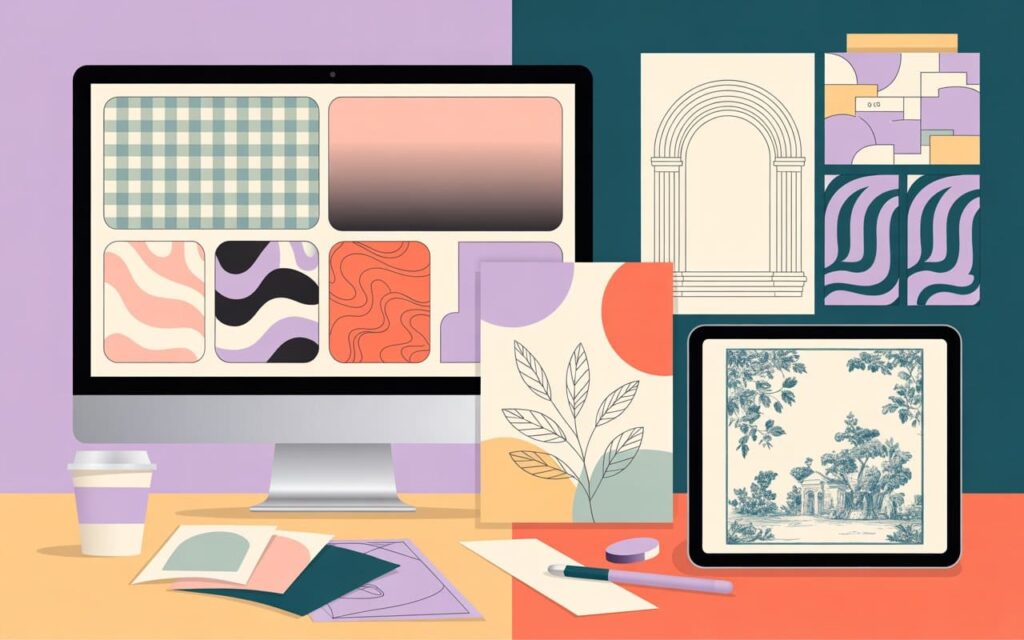
You already know that this trend has come to us from physical products. That is, to such an extent that even toilet paper has become with this… Other types are almost no longer sold because marketers see that even toilet paper with wavy edging sells better. So, it includes doormats, everything related to knitted items, sweaters, belts, shelves, these curtain panels, carpets — and what not is made from these… All edges, which were previously round or straight or rectangular, like a plate or in clothing — are now made with a wavy surface. For example, pillows. Well, in short, all of this now sells better.
So, this concerns just physical goods. But we see the same trend in embroidery and knitting instructions, in embroidery, in large wedding or birthday announcements. Look. So, here’s an invitation — and this edging must definitely be wavy. And you won’t believe it — even when people draw pictures and flowers, they also use it — now it’s more modern to draw a flower with this wavy edging.
And additionally, tangled lines and curls have become more popular now. So, the simple, correct wave shape is now just replaced with curls, elements that look as if hand-drawn.
Trend 4: Contrasting edging
Let’s move on to the next trend. This is the trend of bright outlining — meaning something white or beige, with a black or, shall we say, highly contrasting outline on this background. We very often see this in clothing — what is currently popular. And in furniture. And, well, we often see it in children’s clothing. And, for example, look, even here — a pillow, it has a contrasting line. Or this kind of scarf. And, by the way, this monochromatic picture, you know, blue and blue — well, light blue or darker blue, or lavender.
Well, basically, we see the same in knitting instructions, clothing patterns. Please, a bikini set or children’s clothing. The same can be seen in invitations. So, here, it seems there is no monochromatic look — blue or light lavender and red, but even this red — it is quite contrasting with white. It could just be plain black and white. So, obviously, the people creating these digital products understand very well that this is trending now.
Or even a simple example of a regular invitation with a contrasting detail. Small — could be just at the very edge, “on the edge,” as they say. And… orange, red — it adds a certain relevance and freshness to such an invitation.
Trend 5: Arch
Well, I don’t want to dwell on the next trend for too long because I’ve already talked about it in terms of physical goods. But this arch is still an incredibly popular thing. An arch in invitations, an arch — well, we’ve seen this overall. For example, we discussed the grid, but besides the grid, there was also an arch. So, everything is happening together.
Trend 6: One-line drawings
So, the next topic is — I just really want to cover it because I feel like I haven’t talked about it before in physical product trends. But actually, there is such a trend now. These are some painted items — very often they are flowers, or dogs, or some kind of food, fishes, for example, bottles, spaghetti — anything you can think of. But these are specifically painted with one color. Sometimes a second or third color is added. But the main thing in these drawings is that they look like they are drawn with a single line.
That is, simple pencil drawings, or graphics — they give some kind of, well, I don’t know, soul. Again, it feels as if it is, well, directly written or drawn by human hand. Although, I think that artificial intelligence can also quite easily create such drawings.
Images in digital products
Practically the same items that can be physical, you understand — all of this also applies to digital products. For example, illustrations. Pizza, ice cream — as I already said, food — it’s just super. How popular is this? So much so that my daughter — well, I don’t remember if I told you — made such a little cookbook with recipes. And she personally drew the illustrations for each recipe. She drew her own — her own cake, her own, that is, her own pizza. Everything that was in her recipes, she illustrated all of that herself. And it turned out so cute, so beautiful. Maybe I should make a copy and sell this little album.
Trend 7: Toile de Jouy
The next trend is called Toile de Jouy. Let’s call it Toile de Jouy. I don’t know if I’m pronouncing it correctly in English or French. But if you look at these patterns, you’ll understand — on these physical products — you’ll understand what I mean, the color palette.
These are various images, well, pictures, that were often made on porcelain sets or tablecloths. Overall, it’s a very popular classic French painting style, often used to tell stories or fairy tales. They often depict animals, or people, or flowers, trees, fragments of life. And they are always, again, in this monochromatic color — usually blue (most often blue), but there are also pink, green, and gray versions.
Toile de Jouy in digital goods
Here are examples of this kind of drawings. And it is also transferable — well, this is, of course, a very classic style — but the same drawings are transferred to digital products. For example, an invitation, which is also done in this style. Or, please, a sticker — that’s also a digital product, which is made — well, a personalized sticker, pinkish, very beautiful. A wedding invitation in this style — in green, in a green style. A very popular theme. Well, and various scenes from the life of the 17th or 18th century. Very, very popular.
